
February 2026

Why FinOps Cloud Cost Ownership Fails in Real Time
Uncategorized

Why FinOps Cloud Cost Ownership Fails in Real Time

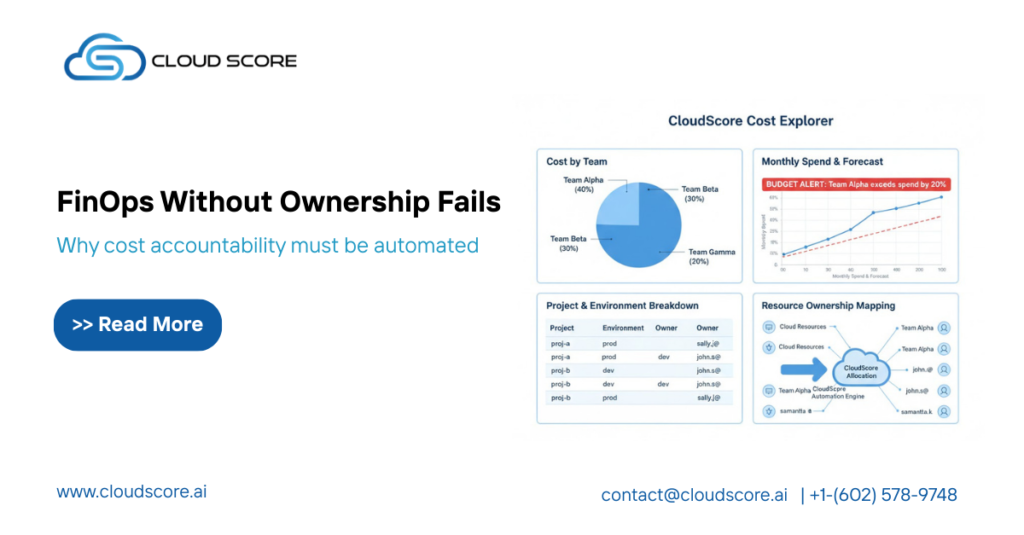
FinOps Has Data — But Still Loses Control  Most organizations today have some form of FinOps tooling. They track cloud spend, generate reports, and review budgets. Yet cloud costs continue to rise quarter after quarter.  The issue isn’t lack of data. The issue is lack of ownership.  Cloud infrastructure is no longer static. Resources are created automatically through CI/CD pipelines, Terraform modules, Kubernetes controllers, and ephemeral environments. Manual tagging policies and spreadsheets simply cannot keep up with this pace.  When no one clearly owns a resource, no one feels responsible for its cost.  Why Traditional FinOps Models Break at Scale  Legacy FinOps assumes:  Static resources  Human-created infrastructure  Finance-owned controls  Monthly or quarterly reviews  Modern cloud environments break all of these assumptions.  In reality:  Engineers create infrastructure automatically  Kubernetes workloads share costs across teams  Environments appear and disappear daily  Budgets are exceeded before alerts fire  By the time finance notices an overrun, the context behind it is gone.  Ownership Is the Missing Layer in FinOps  Without real-time cost ownership:  Engineers don’t see the financial impact of decisions  Finance sees numbers without context  Leadership reacts instead of planning  Cost governance becomes reactive instead of preventative.  How CloudScore Enforces FinOps Ownership by Design  CloudScore was built to make ownership unavoidable.  How CloudScore Enables Engineering-First FinOps:  Automatic Resource Assignment CloudScore assigns resources to teams, projects, services, and environments using intelligent rules—without relying only on tags.  Cost Explorer with Business Context Costs are broken down by team, BU, application, service, environment, and user, with daily, monthly, and yearly views.  Budgets, Forecasts & Anomaly Detection Teams receive real-time alerts for spend spikes, forecast overruns, and unusual behavior—before budgets are exceeded.  Shared Accountability Workflows FinOps becomes a shared responsibility across engineering, finance, and leadership, not a finance-only process.  Slack & Jira Integration Ownership and action happen where teams already work—not in isolated dashboards.  FinOps That Actually Scales  FinOps doesn’t fail because teams don’t care. It fails because systems don’t enforce accountability.     Request a Demo | Start Your Free Trial | Contact Our Experts  See More Blogs: FinOps and SecOps Convergence | DevOps Cloud Cost Visibility | Code Scan | Power Schedules | Multi Cloud Cost Optimization | Untagged Cloud Resources | Best Cloud Governance Solutions | SecOps & FinOps Cloud Governance | AI-Driven FinOps | AI Cloud Cost Optimization | Smart Cost Management | Simplify Cloud Costs | Automated FinOps Platform | Multi-Cloud Spend | Cost Efficiency | Cloud Security | Dynamic Optimization | Seasonality Insights | Cloud Governance | Sustainability Reporting | Cloud Infrastructure | Predictive Analytics | Integrating FinOps | Forecasting  | Automated Cost Management | Cloud Cost Optimization
FinOps and SecOps Convergence
Uncategorized

Why FinOps and SecOps Are Converging in Modern Cloud Platforms

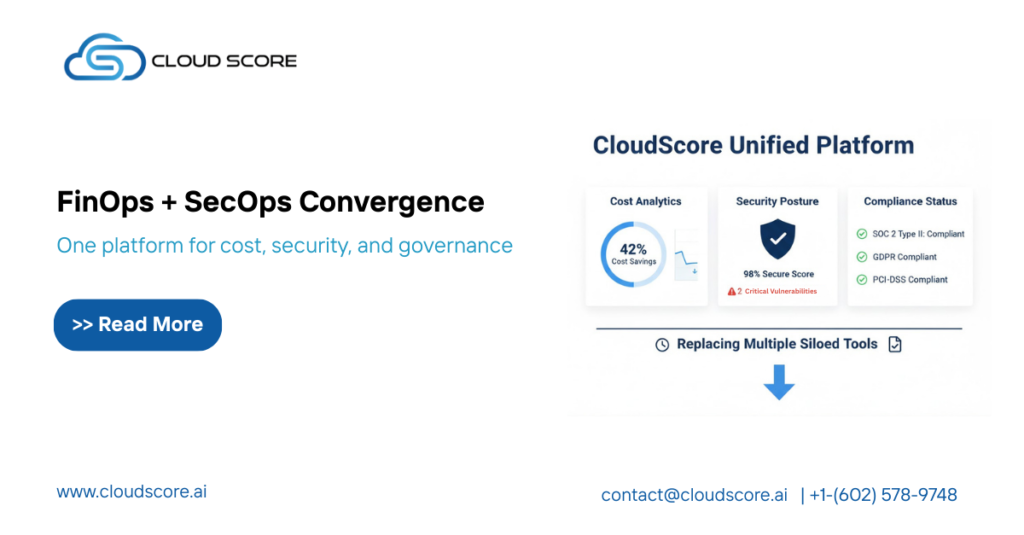
Cloud Complexity Is Forcing a New Model  Cloud environments are no longer simple infrastructure layers. They are:  Multi-cloud  Kubernetes-driven  API-heavy  Data-platform intensive  Security- and compliance-sensitive  Yet most organizations still manage cost and security in silos.  FinOps teams focus on spend. SecOps teams focus on risk. DevOps teams focus on delivery.  The cloud doesn’t operate in silos and neither should the tools.  Cost and Security Are More Connected Than Teams Realize  Many of the biggest cloud risks are also cost risks:  Idle resources increase attack surface and spend  Over-permissioned identities increase breach impact and financial exposure  Misconfigured services create compliance and cost failures  Orphaned assets quietly drain budgets  Without shared visibility, teams solve symptoms—not causes.  Why Tool Sprawl Is No Longer Sustainable  Organizations now operate:  A cost management tool  A CSPM tool  An IAM security tool  A compliance platform  Multiple dashboards  Each tool sees only part of the picture. None correlate cost, usage, ownership, and risk together.  This fragmentation slows response, increases noise, and hides systemic issues.  How CloudScore Unifies FinOps and SecOps  CloudScore was designed as a unified cloud intelligence platform.  What CloudScore does:  Unified Visibility Single-pane visibility across cloud resources, workloads, identities, costs, and risks.  Engineering-First FinOps Real-time cost intelligence, ML-driven optimization, Kubernetes cost management, budgets, forecasts, and anomaly detection.  Built-In SecOps Multi-cloud CSPM, IAM risk detection, misconfiguration monitoring, Kubernetes security, and compliance automation.  Cortex AI Security Analyst Ask security questions in plain English and receive prioritized, context-aware remediation guidance.  Correlation by Design Security findings are correlated with cost, usage, ownership, and lifecycle—not isolated alerts.  Governance Without Slowing Engineering  CloudScore enforces governance through:  Read-only access  Temporary access workflows  Automated ownership rules  Full audit logs  No agents. No production changes. No velocity loss.  The Platform Shift Is Already Happening  FinOps and SecOps are no longer separate concerns. They are two lenses on the same cloud reality.   Request a Demo | Start Your Free Trial | Contact Our Experts  See More Blogs: DevOps Cloud Cost Visibility | Code Scan | Power schedules | Multi Cloud cost optimization | Untagged Cloud Resources | Best Cloud Governance Solutions | SecOps & FinOps Cloud Governance | AI-Driven FinOps | AI Cloud Cost Optimization | Smart Cost Management | Simplify Cloud Costs | Automated FinOps Platform | Multi-Cloud Spend | Cost Efficiency | Cloud Security | Dynamic Optimization | Seasonality Insights | Cloud Governance | Sustainability Reporting | Cloud Infrastructure | Predictive Analytics | Integrating FinOps | Forecasting  | Automated Cost Management | Cloud Cost Optimization
Uncategorized

Why Cloud Costs Spiral Out of Control in Modern DevOps Environments

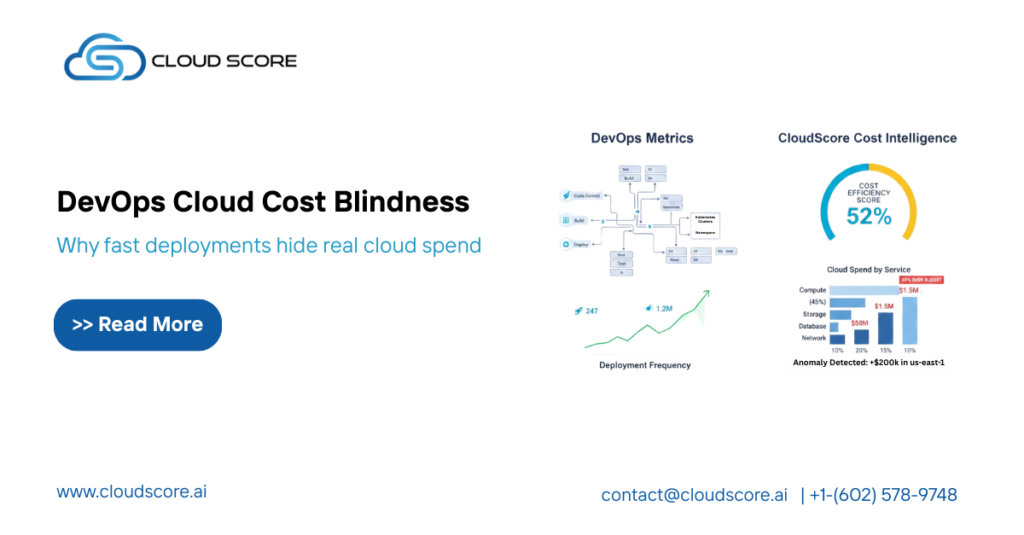
Speed Changed Everything – Visibility Didn’t  DevOps teams today deploy faster than ever. CI/CD pipelines push code multiple times a day. Infrastructure is created automatically using Terraform and GitOps workflows. Kubernetes schedules workloads dynamically across clusters and regions.  Yet while speed evolved, cost visibility did not.  Engineers can instantly detect:  Failed deployments  Latency spikes  Pod crashes  But they cannot see cloud cost impact in real time.  By the time cloud bills arrive, environments have already changed. Pods are gone. Clusters have scaled. Context is lost.  This is how cloud costs spiral without anyone doing something “wrong”.   Why Kubernetes Makes Cost Even Harder to Track  Kubernetes breaks traditional cost models:  Costs are shared across namespaces  Pods are ephemeral  Nodes serve multiple teams  Tags don’t align with workloads  CI/CD pipelines create infra dynamically  Finance tools expect static resources. DevOps runs dynamic systems.  That mismatch creates cost chaos.  When Cost Is Invisible, Ownership Disappears  Without real-time cost visibility:  Engineers optimize performance, not spend  Finance sees overruns without context  Leadership reacts instead of planning  Cost becomes a surprise — not a signal.  How CloudScore Restores DevOps Cost Control  CloudScore is built for engineering-first FinOps, not finance-only reporting.  How it works in practice:  Unified Multi-Cloud Visibility CloudScore provides a single-pane view across AWS, Azure, GCP, Kubernetes, and data platforms, automatically discovering resources, services, workloads, and environments.  Automatic Cost Allocation Beyond Tags Costs are mapped to teams, services, environments, clusters, namespaces, and workloads, even when tags are missing.  Kubernetes-Native Cost Intelligence Engineers see cost by:  Cluster  Namespace  Deployment  Pod Including over-provisioned CPU/memory and idle nodes.  Real-Time Cost Signals Cost becomes an operational metric—visible while decisions are being made, not weeks later.  No Friction by Design Read-only access. No agents. No pipeline changes. Setup in minutes.  The Shift That Changes Everything  When cost moves at the same speed as DevOps, teams don’t slow down – they get smarter.   Request a Demo | Start Your Free Trial | Contact Our Experts  See More Blogs: Code Scan | Power schedules | Multi Cloud cost optimization | Untagged Cloud Resources | Best Cloud Governance Solutions | SecOps & FinOps Cloud Governance | AI-Driven FinOps | AI Cloud Cost Optimization | Smart Cost Management | Simplify Cloud Costs | Automated FinOps Platform | Multi-Cloud Spend | Cost Efficiency | Cloud Security | Dynamic Optimization | Seasonality Insights | Cloud Governance | Sustainability Reporting | Cloud Infrastructure | Predictive Analytics | Integrating FinOps | Forecasting  | Automated Cost Management | Cloud Cost Optimization
code scan
Uncategorized

CloudScore Code Scan: Find Security Issues Before They Go Live

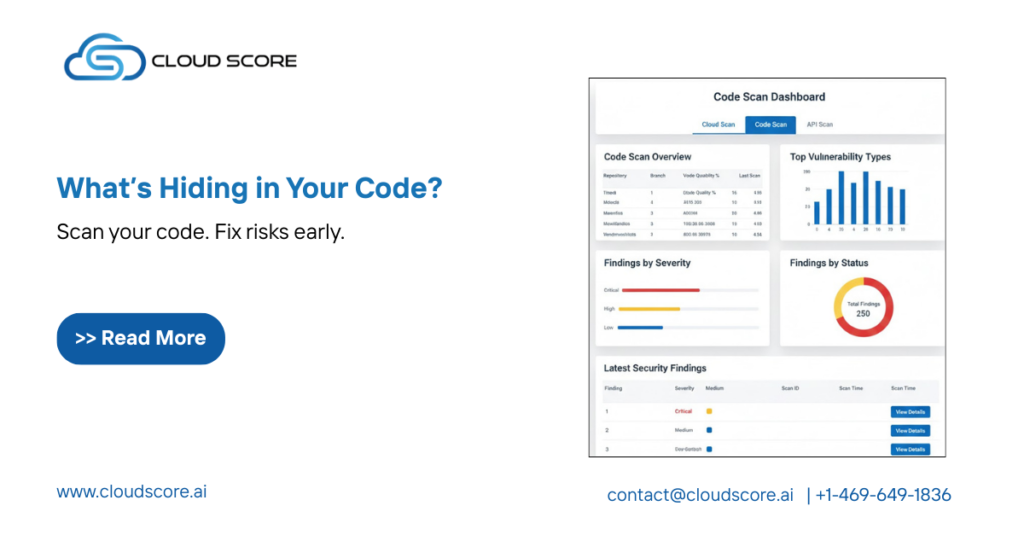
Security issues usually start in code — not in production.But most teams discover them after deployment, when fixes are costly and risky. CloudScore Code Scan helps teams detect security issues early by scanning code directly inside repositories, before anything goes live. What Is CloudScore Code Scan? CloudScore Code Scan is a security code scanning feature that analyzes your source code and highlights vulnerabilities with clear context. It shows: Where the security issue exists in the code How serious the issue is The exact file and line number What needs to be fixed first No noise. No long reports. Just clear results. Why Code Scan Matters Many teams either: Don’t run code scans often Or get scan reports that are hard to understand CloudScore solves this by: Prioritizing Critical and High-risk issues Showing results in a simple dashboard Making fixes easy for developers to act on This turns code scanning into a daily habit — not a once-a-month task. How CloudScore Code Scan Works The process is simple: Connect your GitHub repository (read-only access) Run a code scan on any branch CloudScore scans your code for security issues Results appear instantly in the dashboard No agents. No pipeline slowdown. What You See After a Code Scan For every detected issue, CloudScore displays: Issue name File path and exact line number Severity level (Critical, High, Medium, Low) Repository and branch name Scan date and time Developers know exactly what to fix and where. Built for Real Engineering Teams CloudScore Code Scan supports: Multiple repositories Repeated scans after fixes Tracking issues over time Exporting reports when needed It works smoothly with CI/CD and modern release workflows. Why CloudScore Code Scan Is Different Most tools only scan code. CloudScore connects code scan results with cloud security, giving teams a single view of risk across code and infrastructure. No agents No complex setup No performance impact Just fast, reliable code scanning. Finding security issues late is expensive.Finding them early is smart. CloudScore Code Scan helps teams scan code early, fix issues faster, and ship software with confidence.  Request a Demo | Start Your Free Trial | Contact Our Experts  See More Blogs: Powerschedules | Multi Cloud cost optimization | Untagged Cloud Resources | Best Cloud Governance Solutions | SecOps & FinOps Cloud Governance | AI-Driven FinOps| AI Cloud Cost Optimization | Smart Cost Management | Simplify Cloud Costs | Automated FinOps Platform | Multi-Cloud Spend | Cost Efficiency | Cloud Security | Dynamic Optimization | Seasonality Insights | Cloud Governance | Sustainability Reporting | Cloud Infrastructure | Predictive Analytics | Integrating FinOps | Forecasting  | Automated Cost Management | Cloud Cost Optimization

Scroll to Top