Author name: Bhavishya Kota

Multi Cloud Management Platform
Uncategorized

What Makes a Modern Multi Cloud Management Platform Different?

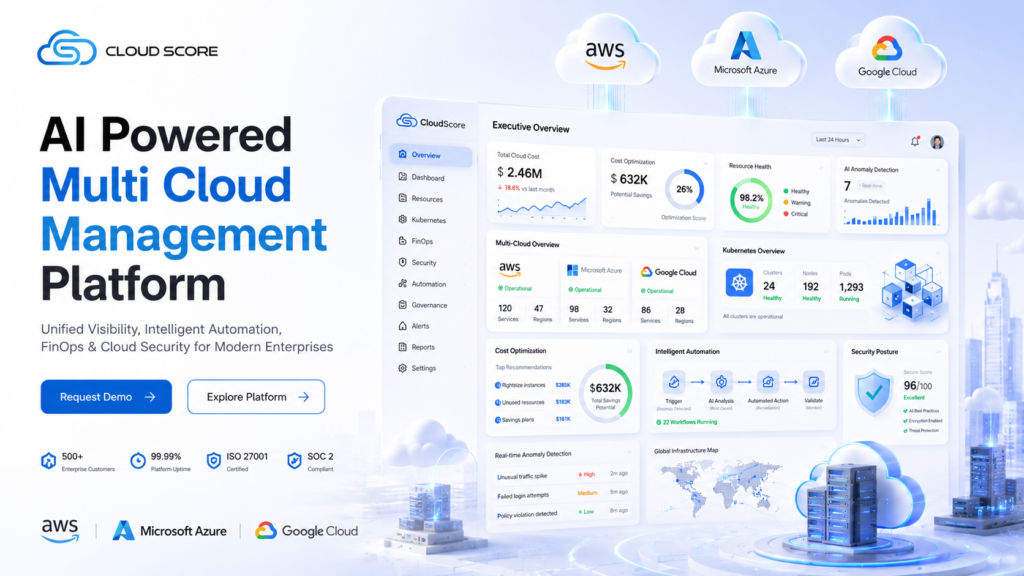
Modern enterprises are rapidly adopting multiple cloud providers to improve scalability, flexibility, and business continuity. However, managing workloads across AWS, Azure, Google Cloud, and hybrid infrastructures creates operational complexity, rising costs, security gaps, and visibility challenges. An AI Powered Multi Cloud Management Platform helps enterprises simplify cloud operations through centralized monitoring, intelligent automation, cost optimization, compliance management, and real-time analytics. Organizations today require more than basic cloud visibility. They need predictive intelligence, automated governance, security-driven operations, and financial accountability across every cloud environment. AI-driven cloud platforms are becoming the foundation for modern cloud operations teams that want to scale efficiently while maintaining control. Why Enterprises Are Moving Toward Multi-Cloud Environments Most enterprises no longer rely on a single cloud provider. Different departments choose different platforms based on workload requirements, pricing models, geographic availability, or specialized services. This creates a multi-cloud ecosystem that often includes: AWS for scalable infrastructure Microsoft Azure for enterprise integrations Google Cloud for AI and analytics Kubernetes environments for containerized applications Hybrid and private cloud systems for sensitive workloads While multi-cloud offers flexibility, it also introduces major operational challenges. Common Multi-Cloud Challenges Lack of centralized visibility Uncontrolled cloud spending Complex compliance management Resource misconfigurations Security vulnerabilities Manual infrastructure monitoring Limited cost forecasting Fragmented operational data Without intelligent cloud management, enterprises struggle to maintain efficiency and governance across distributed environments. What Is an AI Powered Multi Cloud Management Platform? An AI Powered Multi Cloud Management Platform is a centralized cloud operations solution that uses artificial intelligence and automation to manage infrastructure, security, governance, performance, and cloud costs across multiple cloud providers. Instead of manually monitoring separate cloud dashboards, enterprises can manage everything from a unified platform. The platform continuously analyzes cloud usage patterns, detects anomalies, identifies optimization opportunities, automates governance policies, and improves operational decision-making using AI models. Key Features of an AI Powered Multi Cloud Management Platform 1. Unified Multi-Cloud Visibility A centralized dashboard provides complete visibility into: Cloud assets Running workloads Resource utilization Network activity Security posture Cost allocation Kubernetes clusters Teams can monitor all cloud environments from a single interface without switching between providers. 2. AI-Driven Cloud Cost Optimization Cloud spending is one of the biggest concerns for enterprises operating across multiple clouds. AI-powered platforms help reduce waste by: Detecting idle resources Recommending right-sizing opportunities Identifying underutilized workloads Forecasting future cloud spend Automating budget alerts Optimizing reserved instances This enables FinOps teams to gain financial control and improve cloud ROI. 3. Intelligent Security & Compliance Monitoring Modern enterprises require continuous cloud security monitoring. AI-powered platforms help organizations: Detect misconfigurations Monitor IAM risks Identify vulnerabilities Track compliance violations Enforce governance policies Automate audit reporting Continuous monitoring reduces security risks while maintaining compliance across cloud environments. 4. Predictive Analytics & Anomaly Detection Artificial intelligence helps operations teams identify issues before they impact production environments. AI models can: Detect abnormal cloud activity Predict workload spikes Identify unusual spending patterns Forecast infrastructure capacity Reduce downtime risks This proactive approach improves operational reliability and cloud performance. 5. Kubernetes & Container Management Modern applications increasingly rely on Kubernetes and containerized environments. An advanced Multi Cloud Management Platform helps teams: Monitor Kubernetes clusters Track container costs Optimize cluster performance Improve resource allocation Enhance workload stability AI-powered insights simplify container operations at scale. 6. Automation & Workflow Intelligence Manual cloud operations consume engineering time and slow business agility. AI automation helps enterprises: Automate policy enforcement Trigger incident alerts Streamline workflows Reduce repetitive tasks Improve operational efficiency Automation enables teams to focus on innovation instead of manual cloud management. Benefits of AI Powered Multi Cloud Management Improved Operational Efficiency Unified cloud operations reduce complexity and improve infrastructure management across environments. Better Financial Governance AI-powered cost intelligence improves budgeting, forecasting, and cloud spend optimization. Enhanced Security Posture Continuous monitoring and automated compliance help reduce enterprise security risks. Faster Decision-Making Real-time analytics and predictive insights help leadership teams make data-driven cloud decisions. Scalability for Modern Enterprises AI-powered cloud platforms support enterprise growth without increasing operational overhead. Why AI Is Becoming Essential for Cloud Operations Cloud environments generate massive amounts of operational data every second. Manual analysis is no longer practical for modern enterprises. Artificial intelligence helps organizations: Process cloud telemetry at scale Detect operational inefficiencies Automate infrastructure analysis Improve cloud governance Accelerate incident response Reduce human error AI transforms cloud operations from reactive management into proactive intelligence. Choosing the Right Multi Cloud Management Platform When evaluating a platform, enterprises should look for: Multi-cloud compatibility AI-powered analytics Real-time monitoring FinOps capabilities Security & compliance automation Kubernetes visibility Workflow integrations Scalability Read-only architecture Enterprise-grade reporting The right platform should simplify cloud complexity while improving governance, visibility, and cost control. The Future of Multi-Cloud Operations As enterprises continue expanding across cloud providers, AI-driven cloud management will become a business necessity rather than an optional tool. Future-ready organizations will rely on intelligent cloud platforms to: Automate cloud operations Improve infrastructure efficiency Strengthen security governance Reduce operational costs Accelerate innovation AI-powered cloud management platforms are shaping the future of enterprise cloud operations. Managing modern cloud infrastructure requires more than traditional monitoring tools. Enterprises need intelligent systems capable of optimizing costs, improving visibility, automating operations, and strengthening security across distributed cloud environments. An AI Powered Multi Cloud Management Platform enables organizations to simplify complexity, improve governance, and scale cloud operations efficiently. By combining artificial intelligence, automation, FinOps, and security intelligence, enterprises can achieve greater control over their multi-cloud ecosystem while accelerating digital transformation. Why Modern Enterprises Choose CloudScore Enterprises require cloud platforms that combine visibility, governance, automation, and intelligence. CloudScore helps organizations: Simplify multi-cloud complexity Improve cloud cost governance Strengthen cloud security posture Enhance operational efficiency Accelerate cloud decision-making Scale cloud infrastructure confidently Its engineering-first architecture enables enterprises to modernize cloud operations without sacrificing governance or visibility. Simplify multi-cloud operations with AI-powered automation by CloudScore  Request a Demo | Start Your Free Trial | Contact Our Experts  See More Blogs: Multi Cloud Financial Management | AI-Powered FinOps Platform | Cloud Cost Anomaly Detection Platform | Cloud Cost Reduction | Multi Cloud Cost Intelligence | Multi Cloud Cost Visibility | Cloud Cost Optimization Platform | CloudOps Cost Optimization | Cloud Security
Cloud Cost Optimization Platform
Uncategorized

Cloud Cost Optimization Platform: From Cost Visibility to Real Control

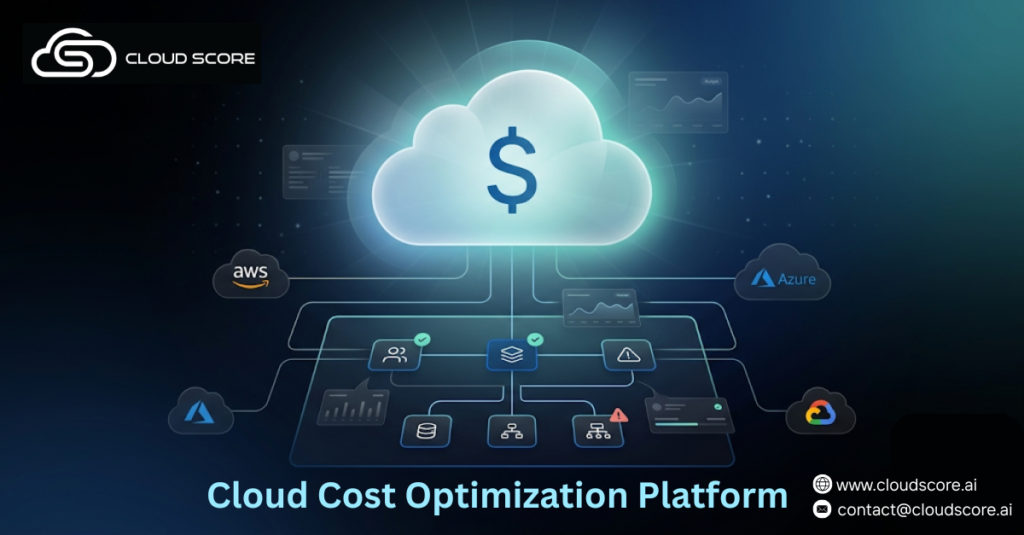
Over the last few years, organizations have invested heavily in cloud infrastructure – expecting scalability, flexibility, and efficiency. What they got instead was complexity and rising costs. Most teams today already have dashboards. They can see: Monthly cloud bills Service-wise spending Usage reports Yet despite all this visibility, one problem persists: 👉 Cloud costs continue to rise. Visibility shows you what happened.But it doesn’t give you the ability to control what happens next. The Real Problem Behind Rising Cloud Costs Cloud spending is not driven by finance teams – it’s driven by engineering decisions. Every deployment, scaling action, or architectural choice impacts cost. However, in most organizations: Engineering lacks cost context Finance lacks technical depth Leadership lacks real-time control This creates a gap where: Costs grow silently Inefficiencies go unnoticed Optimization happens too late By the time reports highlight an issue, the spend has already occurred. What a Cloud Cost Optimization Platform Should Actually Deliver A modern Cloud Cost Optimization Platform is not just a reporting tool. It is a system designed to bridge the gap between visibility and action. Real-Time Cost Visibility Across Infrastructure To control costs, you first need complete clarity. This includes: Multi-cloud environments (AWS, Azure, GCP) Kubernetes and container workloads Data pipelines and storage layers Team, service, and environment-level allocation Without this level of granularity, optimization is guesswork. From Insights to Immediate Action Most tools stop at insights.Modern platforms go further. They enable: Rightsizing recommendations based on real usage Detection of idle or underutilized resources Immediate actions to eliminate waste This reduces the delay between problem identification and resolution. Engineering-Led Cost Ownership True optimization happens when engineering teams take ownership of costs. A Cloud Cost Optimization Platform should: Map costs to teams and services Provide actionable insights within engineering workflows Align infrastructure decisions with financial impact This transforms cost management from a finance function into a shared responsibility. Intelligent Automation Forecasting Manual tracking cannot keep up with dynamic cloud environments. Modern platforms introduce: Real-time anomaly detection Budget alerts before overspending Predictive cost forecasting This ensures organizations move from reactive monitoring to proactive control. Why Most Organizations Still Struggle to Optimize Cloud Costs Despite adopting multiple tools, many teams fail to reduce cloud spend effectively. The core reason: 👉 They have visibility without execution. Dashboards highlight problems.Reports explain trends. But without a system that enables action, organizations are left with: Delayed decisions Fragmented workflows Missed optimization opportunities CloudScore: Turning Visibility Into Real Control CloudScore is designed to solve this exact problem. It is a unified Cloud Cost Optimization Platform built for modern, engineering-driven environments. Engineering-First Approach CloudScore is built for the teams that actually influence cloud spend: DevOps Platform Engineering Infrastructure teams This ensures cost optimization happens at the source not after the fact. Unified FinOps + SecOps Platform CloudScore combines: Cost optimization Security insights Compliance visibility All within a single platform. This eliminates the need for multiple disconnected tools and provides complete operational clarity. Deep Cloud Intelligence Modern architectures require deeper insights. CloudScore delivers visibility into: Kubernetes workloads Data and storage usage MLOps environments This enables precise and meaningful optimization. Real-Time Optimization and Automation With CloudScore: Cost anomalies are detected instantly Recommendations are actionable Integrations with Slack and Jira accelerate response This reduces waste before it impacts budgets. Secure, Read-Only Access CloudScore operates with a non-intrusive model: No changes to your infrastructure No operational risk Full visibility and insights You gain control without disruption. The Business Impact of Moving to Real Cost Control Organizations that adopt a true Cloud Cost Optimization Platform experience: Reduced unnecessary cloud spend Improved cost predictability Faster decision-making Better alignment between engineering and finance Cloud becomes not just scalable but financially efficient. The Shift from Visibility to Control Cloud cost management is evolving. The question is no longer:👉 “Can you see your cloud costs?” The real question is:👉 “Can you control them in real time?” A modern Cloud Cost Optimization Platform enables organizations to: Act instantly Optimize continuously Scale efficiently Because in today’s cloud environment, success is not defined by how much you spend— But by how effectively you control it. If your organization is still relying on reports and dashboards, you are only solving half the problem. It’s time to move beyond visibility. Start controlling your cloud costs with CloudScore.    Request a Demo | Start Your Free Trial | Contact Our Experts  See More Blogs: CloudOps Cost Optimization | Cloud Security Posture Management | Cloud Intelligence Platform | DevOps Environment Sprawl | FinOps Cloud Cost Ownership | FinOps and SecOps Convergence | DevOps Cloud Cost Visibility | Code Scan | Power Schedules | Multi Cloud Cost Optimization | Untagged Cloud Resources | Best Cloud Governance Solutions | SecOps & FinOps Cloud Governance | AI-Driven FinOps | AI Cloud Cost Optimization | Smart Cost Management | Simplify Cloud Costs | Automated FinOps Platform | Multi-Cloud Spend | Cost Efficiency | Cloud Security | Dynamic Optimization | Seasonality Insights | Cloud Governance | Sustainability Reporting | Cloud Infrastructure | Predictive Analytics | Integrating FinOps | Forecasting | Automated Cost Management | Cloud Cost Optimization
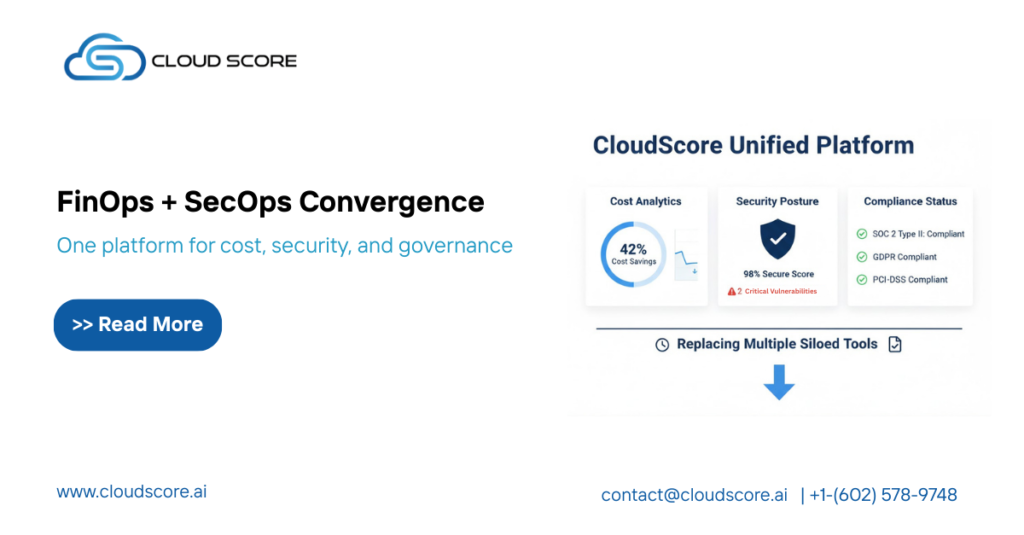
FinOps and SecOps Convergence
Uncategorized

Why FinOps and SecOps Are Converging in Modern Cloud Platforms

Cloud Complexity Is Forcing a New Model  Cloud environments are no longer simple infrastructure layers. They are:  Multi-cloud  Kubernetes-driven  API-heavy  Data-platform intensive  Security- and compliance-sensitive  Yet most organizations still manage cost and security in silos.  FinOps teams focus on spend. SecOps teams focus on risk. DevOps teams focus on delivery.  The cloud doesn’t operate in silos and neither should the tools.  Cost and Security Are More Connected Than Teams Realize  Many of the biggest cloud risks are also cost risks:  Idle resources increase attack surface and spend  Over-permissioned identities increase breach impact and financial exposure  Misconfigured services create compliance and cost failures  Orphaned assets quietly drain budgets  Without shared visibility, teams solve symptoms—not causes.  Why Tool Sprawl Is No Longer Sustainable  Organizations now operate:  A cost management tool  A CSPM tool  An IAM security tool  A compliance platform  Multiple dashboards  Each tool sees only part of the picture. None correlate cost, usage, ownership, and risk together.  This fragmentation slows response, increases noise, and hides systemic issues.  How CloudScore Unifies FinOps and SecOps  CloudScore was designed as a unified cloud intelligence platform.  What CloudScore does:  Unified Visibility Single-pane visibility across cloud resources, workloads, identities, costs, and risks.  Engineering-First FinOps Real-time cost intelligence, ML-driven optimization, Kubernetes cost management, budgets, forecasts, and anomaly detection.  Built-In SecOps Multi-cloud CSPM, IAM risk detection, misconfiguration monitoring, Kubernetes security, and compliance automation.  Cortex AI Security Analyst Ask security questions in plain English and receive prioritized, context-aware remediation guidance.  Correlation by Design Security findings are correlated with cost, usage, ownership, and lifecycle—not isolated alerts.  Governance Without Slowing Engineering  CloudScore enforces governance through:  Read-only access  Temporary access workflows  Automated ownership rules  Full audit logs  No agents. No production changes. No velocity loss.  The Platform Shift Is Already Happening  FinOps and SecOps are no longer separate concerns. They are two lenses on the same cloud reality.   Request a Demo | Start Your Free Trial | Contact Our Experts  See More Blogs: DevOps Cloud Cost Visibility | Code Scan | Power schedules | Multi Cloud cost optimization | Untagged Cloud Resources | Best Cloud Governance Solutions | SecOps & FinOps Cloud Governance | AI-Driven FinOps | AI Cloud Cost Optimization | Smart Cost Management | Simplify Cloud Costs | Automated FinOps Platform | Multi-Cloud Spend | Cost Efficiency | Cloud Security | Dynamic Optimization | Seasonality Insights | Cloud Governance | Sustainability Reporting | Cloud Infrastructure | Predictive Analytics | Integrating FinOps | Forecasting  | Automated Cost Management | Cloud Cost Optimization

AI Cloud Cost Optimization - How Intelligent Automation is Redefining FinOps
Uncategorized

AI Cloud Cost Optimization – How Intelligent Automation is Redefining FinOps

In today’s multi-cloud world, managing cloud costs has become a high-stakes challenge. From underutilized resources to unpredictable usage spikes, cloud spending can spiral out of control without intelligent monitoring. Enter AI Cloud Cost Optimization a transformative approach that blends automation, predictive analytics, and real-time visibility to help enterprises achieve financial efficiency and operational control. AI is not just automating cloud governance it’s redefining FinOps, giving businesses the intelligence they need to make smarter cloud investment decisions. What is AI Cloud Cost Optimization? AI Cloud Cost Optimization leverages algorithms, behavioral analytics and automated policies to identify inefficiencies and optimize cloud resource allocation.Instead of relying on manual reviews or static cost reports, AI systems continuously analyze patterns in usage, performance and billing, delivering real-time recommendations to reduce costs without compromising performance. AI-based FinOps tools like CloudScore use dynamic algorithms that automatically scale resources, shut down idle workloads and predict future spending patterns based on historical data. Key Benefits of AI Cloud Cost Optimization 1. Real-Time Cost Visibility AI-powered dashboards give organizations a granular view of their cloud expenses broken down by region, service, and department. This transparency helps teams pinpoint cost anomalies before they escalate. 2. Resource Right-Sizing AI continuously analyzes workloads and adjusts compute, storage, and network resources to prevent both over-provisioning and under-provisioning. 3. Predictive Spend Forecasting Forecasting models track historical usage to predict future expenses empowering finance teams to plan budgets and avoid surprise billing. 4. Anomaly Detection & Alerts AI can instantly detect irregular spikes in cloud consumption and trigger alerts, ensuring proactive intervention and eliminating unnecessary financial waste. 5. Multi-Cloud Cost Governance With most enterprises operating across AWS, Azure, and Google Cloud, AI provides a centralized governance framework ensuring compliance, standardization, and policy enforcement across all platforms. How AI Transforms Traditional FinOps Traditional FinOps relies heavily on manual reporting and static analysis, which often leads to delayed cost control actions. AI-driven systems, however, operate continuously and autonomously offering 24/7 cloud monitoring and actionable intelligence. By integrating with APIs from major cloud providers, AI FinOps platforms like CloudScore automatically: Identify cost-saving opportunities (unused instances, over-provisioned VMs) Recommend optimal pricing models (Reserved vs. On-Demand vs. Spot) Enforce tagging compliance and governance Provide visual cost breakdowns per project or department This constant feedback loop creates a self-optimizing cloud environment, where cost efficiency is built into every deployment. Real-World Impact of AI Cloud Cost Optimization Companies that have adopted AI-driven cost optimization strategies report: Up to 30% reduction in annual cloud expenditure 25–30% improvement in resource utilization efficiency Faster ROI through continuous cost governance By automating decision-making, AI reduces dependency on human intervention and ensures financial accountability across engineering, DevOps, and finance teams. Future of AI in Cloud Cost Management The next evolution of FinOps will move toward self-healing cloud ecosystems where AI not only monitors but also executes autonomous cost adjustments in real time.Expect to see tighter integrations between FinOps and Cloud Governance platforms, ensuring that every byte of cloud data is optimized for both performance and cost. As organizations continue to scale cloud adoption, AI Cloud Cost Optimization will no longer be a luxury it will be a strategic necessity for sustainable digital growth. Outcome AI Cloud Cost Optimization is transforming how businesses view and manage their cloud investments. By automating monitoring, forecasting, and governance, companies can reduce waste, maximize ROI, and strengthen their financial posture in an increasingly digital economy. If your organization is seeking smarter ways to manage cloud spend, it’s time to embrace AI-driven FinOps where cost efficiency meets intelligent automation. Start optimizing your cloud costs with CloudScore’s AI-powered FinOps platform.Gain full visibility, automate governance and forecast spend intelligently.  Request a Demo | Start Your Free Trial | Contact Our Experts See more Blogs: Smart Cost Management | Simplify Cloud Costs | Automated FinOps Platform | Multi-Cloud Spend | Cost Efficiency | Cloud Security | Dynamic Optimization | Seasonality Insights | Cloud Governance | Sustainability Reporting | Cloud Infrastructure | Predictive Analytics | Integrating FinOps | Forecasting  | Automated Cost Management | Cloud Cost Optimization

Scroll to Top