
AI Governance for AI Agents: From Policy to Runtime Control
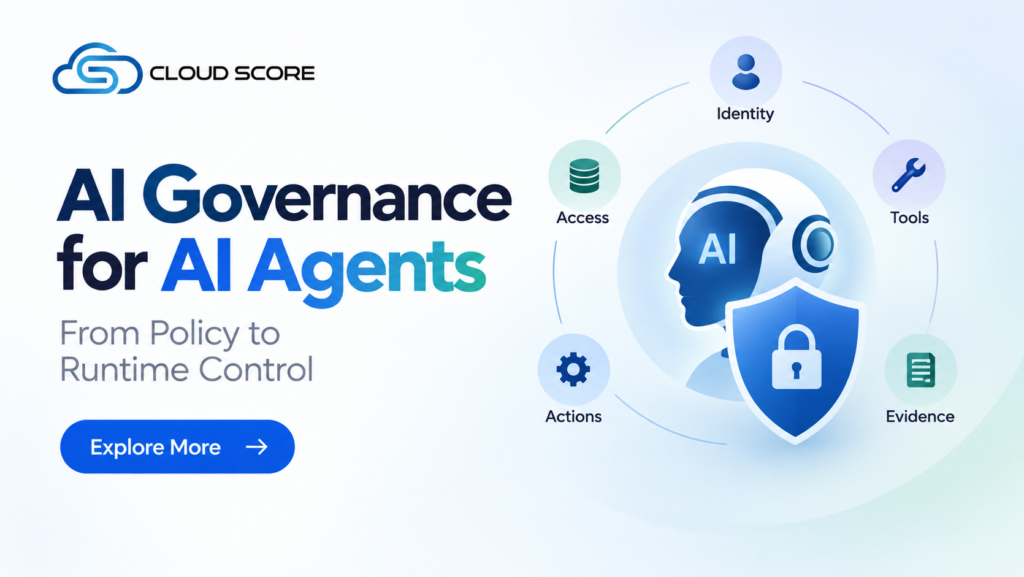
AI Governance is entering a new phase. As enterprises move from AI assistants and copilots toward AI agents, the challenge is no longer only about approving models or reviewing AI-generated outputs. A traditional AI model generates an answer. An AI agent can take an action. It can analyze information, call APIs, interact with business applications, access data, trigger workflows, and operate across connected systems. That creates a more important enterprise question:What is the AI agent allowed to do, and how can the organization keep that under control as the environment changes? This is where modern AI Governance becomes operational. What Makes AI Agent Governance Different? Traditional governance often focuses on model approval, risk assessment, data protection, responsible use, and compliance. AI agents add another dimension: autonomy. An agent may have: An identity Data access API permissions Connected tools Application access Cloud resources The ability to perform actions The model is therefore only one part of the governance picture. An enterprise also needs to understand: Who is using the agent? What can it access? Which tools can it use? What actions can it perform? What happens when the environment changes? This shifts the focus from simply governing the model to governing the agent, its capabilities, and its actions. The Shift From Model Governance to Action Governance Imagine an AI agent originally designed to analyze customer information. Later, it receives permission to update customer records. The business use case may look almost identical. The governance risk is not. A stronger approach therefore considers: Model + Agent + Identity + Data + Tools + Permissions + Actions This gives enterprises a more complete view of how AI operates inside the business. The important question becomes:Is the agent operating within the boundaries it was originally approved for? The 5 Core Areas of AI Agent Governance 1. Identity Every AI agent should have a clearly defined identity. Organizations should be able to determine which agent is acting, which application initiated the activity, and which user or workflow is behind the request. Clear identity makes accountability possible. 2. Access An agent should only have access to the information and systems required for its intended purpose. That may include: Enterprise data Internal documents Databases Applications APIs Cloud resources The principle is simple:Give the agent the access it needs-not the access it might eventually need. 3. Tools Tools turn an AI model into an operational system. An agent may connect to APIs, databases, search services, cloud platforms, internal applications, or automation tools. Each connection expands its capabilities. Each capability becomes another governance point. 4. Actions Not every action has the same impact. Analyzing information is different from modifying it. Updating a record is different from changing a production workload. Sending a recommendation is different from executing a transaction. A mature governance model should therefore define: Which actions are allowed? Which actions require approval? Which actions should never be automated? 5. Evidence Organizations need to understand what happened. What did the agent analyze? Which tools did it use? What did it change? Which decision did it make? What triggered the action? Good governance creates enough evidence to make important AI activity understandable and accountable. Governance Must Continue After Deployment One of the biggest mistakes an enterprise can make is treating governance as a one-time approval. Environments change constantly. Models change. Permissions change. Applications change. Tools are added. Cloud resources scale. Workflows evolve. Costs change. Agent behavior can change as its surrounding context changes. This makes runtime governance increasingly important. Organizations need to identify meaningful changes such as: New permissions New tool connections Changes in agent scope Unusual activity Unexpected data access Policy violations Infrastructure changes Cost increases Dependency changes The objective is not to monitor every event equally. It is to identify changes that could materially affect risk, behavior, cost, reliability, or business impact. That turns governance from a document into a continuous operating practice. AI Governance and Cloud Environments AI agents rarely operate alone. A typical enterprise workflow may look like: Agent → Application → API → Database → Cloud Infrastructure A problem anywhere in that chain can affect the AI workload. A change in infrastructure can affect reliability. A change in permissions can affect access. A change in cloud consumption can affect cost. A change in a connected service can affect the agent’s ability to complete a task. This means an effective governance approach needs context across: AI + Applications + Data + Infrastructure + Cost + Operations The more connected the agent becomes, the more important that context becomes. AI Agent Governance and Cost Control AI Governance is not only about permissions and accountability. Agentic workloads can create complex consumption across: Model inference LLM usage APIs GPUs Compute Databases Vector stores Networking Cloud services That leads to a practical question:What does one successful AI workflow actually cost? The answer may involve much more than the model itself. It can include tool calls, repeated context, infrastructure consumption, data retrieval, and multiple model interactions. That makes efficiency an important part of responsible AI operations. Token Optimization Efficient token usage matters because repeated context, oversized prompts, and unnecessary model calls can increase AI consumption. AI Governance should include visibility into token usage and encourage efficient model and prompt usage. Cache Management Appropriate caching can reduce repeated processing and unnecessary model calls. AI Governance should ensure cached data remains subject to the right privacy, access, and retention controls. Governing Agent Permissions and Actions An agent’s capabilities should match its approved purpose. An agent that can analyze information does not automatically need permission to modify records. An agent that can update an application may not need access to unrelated systems. A practical framework should define: What the agent can access What tools it can use What actions it can perform Which actions require approval What happens when it exceeds its permitted scope This makes autonomy measurable instead of ambiguous. The objective is not to prevent useful automation. It is to make sure that autonomous actions happen within clearly defined boundaries.