
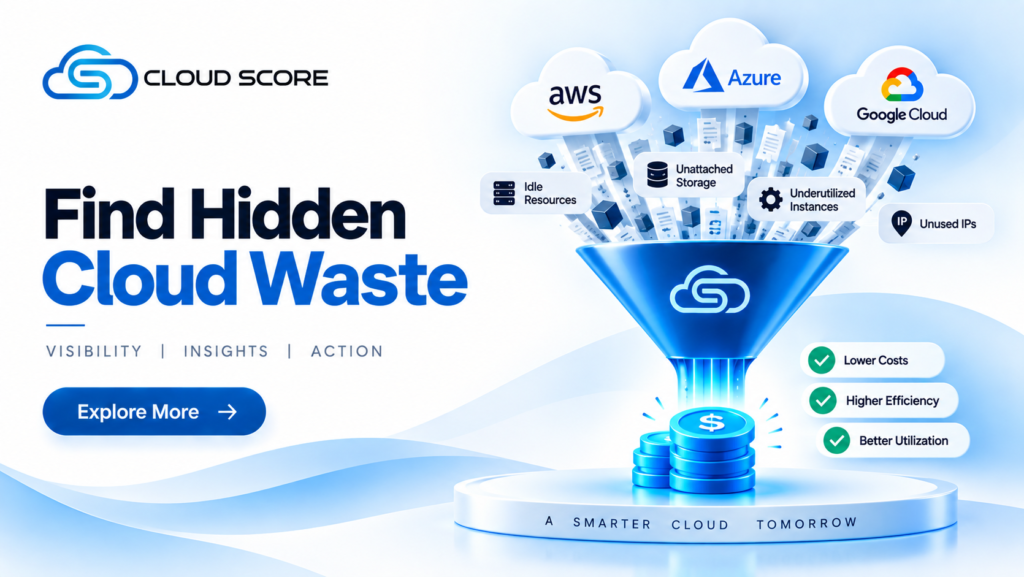
Your cloud bill increased.
You know the number. But can you quickly answer what changed, where it changed, what is driving it, and whether it requires action?
That is where cloud cost management becomes challenging.
As cloud environments grow across AWS, Azure, GCP, and other providers, spending can become distributed across services, resources, regions, and workloads. Each cloud provider offers detailed cost and usage information, but connecting that information to the resources and workloads driving the spend can require significant time and effort.
CloudScore brings that connection together in one SaaS platform.
With Multi-Cloud Visibility, Cloud Economics, Resource & Usage Insights, AI-Driven Optimization Recommendations, Automated Remediation, DEX Bot, and LLMOps, CloudScore helps organizations understand where their cloud spend is going, uncover the factors driving it, identify actionable optimization opportunities, and automate the remediation of detected waste.
From visibility and investigation to intelligent recommendations and automated action, CloudScore enables teams to continuously optimize cloud costs, resource utilization, and AI workloads.
Your Cloud Bill Is Only the Starting Point
A higher cloud bill does not automatically mean waste.
Your organization may be handling more traffic. A workload may genuinely require additional capacity. New services may be supporting new business requirements.
The more difficult cases are the ones that are less obvious.
A resource may be provisioned with more capacity than its workload requires. Usage may remain consistently low while costs continue. Spending may increase across multiple services, making the underlying cause difficult to identify.
That is why an invoice alone is not enough.
The real opportunity is connecting cost with usage, resources, workloads, and the context behind the spend.
That is where CloudScore starts.
One View Across Your Cloud Environment
Multi-Cloud Visibility
CloudScore brings cloud spending across AWS, Azure, GCP, and OCI into one platform.
Instead of collecting information from separate provider dashboards and manually building a consolidated view, teams can start with a unified picture of their cloud environment.
CloudScore helps teams understand:
- Spending by cloud provider
- Spending by service
- Changes and trends over time
- Resource information
- Usage information
- Areas that may require further investigation
For organizations operating across multiple cloud environments, this creates a simpler starting point:
One view. Multiple clouds. A clearer path to investigation.
Discover What’s Driving Changes in Cloud Spend
Cloud Economics
Knowing how much you spend is only the beginning. The real value comes from understanding where your cloud costs are increasing or decreasing, what is driving those changes, and whether they require action.
CloudScore’s Cloud Economics capabilities provide a consolidated view of cost trends and spending patterns across your cloud environment. This helps teams quickly identify significant changes, drill into the areas behind them, and determine whether further investigation is needed.
The journey is simple:
Spending Changes → Identify the Trend → Pinpoint the Area → Investigate the Resources → Understand the Cause
Not every increase in cost represents waste. It could be driven by business growth, increased workload demand, or additional infrastructure requirements. In other cases, it may reveal an opportunity to optimize.
CloudScore provides the context teams need to understand the difference, prioritize the right opportunities, and make informed decisions.
Follow the Spend to the Resource
Resource & Usage Insights
A service-level cost tells you where money is being spent.
The next question is:
Which resources are driving that spend?
CloudScore helps teams move from high-level cost information into resource and usage details, making it easier to investigate what is behind the numbers.
The analysis can follow a simple path:
Provider → Service → Resource → Usage → Cost
This gives FinOps and engineering teams a practical way to investigate spending rather than stopping at the top-level bill.
It also makes optimization conversations more precise by connecting financial information with the technical resources and usage patterns behind it.
Identify Underutilized Capacity
Utilization Analysis
A resource can be active and still have more capacity than its workload requires.
CloudScore helps teams identify utilization patterns that may deserve a closer look, allowing them to evaluate whether the capacity provisioned is aligned with actual workload requirements.
Importantly, low utilization does not automatically mean a resource should be removed or changed.
Instead, CloudScore provides the context needed to evaluate the situation.
The question becomes:
Does this resource still need the capacity we are paying for?
That is a more useful starting point for cloud optimization than simply looking for the highest-cost resources.
Right-Size Based on Real Usage
Align Capacity With Workload
Right-sizing is not simply about making infrastructure smaller.
It is about aligning provisioned capacity with actual workload requirements.
CloudScore brings usage, capacity, and cost information together to help teams evaluate potential right-sizing opportunities.
Teams can compare:
Actual Usage ↔ Provisioned Capacity ↔ Cloud Spend
This gives FinOps and engineering teams a stronger basis for determining whether a resource configuration should be reviewed.
The objective is not to reduce infrastructure at any cost.
The objective is to make capacity better match the work it supports.
Find the Opportunities Worth Reviewing
AI-Driven Optimization Recommendations
Large cloud environments can contain thousands of resources. Manually reviewing each one is neither practical nor efficient.
CloudScore uses AI-Driven Optimization Recommendations to help surface opportunities that may deserve attention.
Rather than starting with an overwhelming list of resources, teams can start with recommendations based on cloud cost, resource, and usage information.
The workflow becomes:
Identify → Review → Validate → Act
This helps reduce the manual effort involved in discovering potential optimization opportunities while keeping teams in control of the final decision.
The goal is not to automate every decision.
The goal is to help teams focus their attention on the opportunities that matter most.
Turn Recommendations Into Action
Automated Remediation
Identifying waste is only part of the optimization process.
The next challenge is turning validated opportunities into action.
CloudScore’s Automated Remediation capabilities help organizations move from identified optimization opportunities toward remediation, reducing the manual effort involved in addressing detected waste.
The workflow can move from:
Detect → Recommend → Validate → Remediate → Monitor
This creates a more continuous approach to cloud optimization instead of relying entirely on manual reviews and one-time cleanup exercises.
The value is not just finding waste—it is helping teams act on it.
Improve the Digital Employee Experience
DEX Bot
Cloud and infrastructure issues do not only affect systems and costs. They can also affect the people using those systems.
CloudScore’s DEX Bot helps organizations bring visibility into the digital employee experience, helping teams identify issues that may affect user productivity and experience.
By connecting operational context with the broader technology environment, teams can investigate issues more effectively and focus on improving the experience of the people who depend on their technology.
Better visibility helps teams move from reacting to user issues toward understanding and addressing their underlying causes.
Bring AI Workloads Into FinOps
LLMOps
AI is introducing a new dimension to technology spending.
As organizations adopt large language models across applications and business processes, AI workloads can become a meaningful part of the overall cost and operational picture.
CloudScore’s LLMOps capabilities help organizations understand and manage their AI workloads by bringing visibility into AI usage, performance, and cost.
Teams can ask:
How much are we spending on AI workloads?
Where is that spending occurring?
What is driving the usage and cost?
How can AI workloads be optimized?
By bringing AI workload management into the broader cloud and FinOps conversation, organizations can make more informed decisions about how they build, operate, and scale AI applications.
Give FinOps and Engineering the Same Picture
One View for Financial and Technical Decisions
Cloud optimization is not owned by a single team.
FinOps understands the financial impact.
Engineering understands workloads, infrastructure, and resource requirements.
Technology leaders need the broader picture to make informed decisions.
CloudScore brings cost, usage, resource, optimization, operational, and AI workload information together in one SaaS platform.
This creates a more focused conversation.
Instead of:
“Cloud spending has increased.”
Teams can discuss:
“This area has changed, these resources are contributing to it, this opportunity has been identified, and here is the action we can take.”
That is the difference between reporting a problem and understanding what to do about it.
Why a Unified SaaS Approach Matters
Go Beyond Provider-by-Provider Cost Reporting
AWS, Azure, GCP, and OCI each provide their own cost and usage information.
The challenge becomes more complex when organizations need to understand their entire cloud environment together.
CloudScore provides a centralized SaaS platform for organizations that need to:
- See spending across cloud providers
- Understand cost trends
- Investigate the resources behind spending
- Evaluate usage and capacity
- Identify optimization opportunities
- Automate remediation
- Improve digital employee experience
- Manage and optimize AI workloads
Instead of building the complete picture manually across multiple provider dashboards and data sources, teams have one consistent platform from which to understand, investigate, and optimize their technology environment.
Why CloudScore
The Capabilities Behind the Platform
Multi-Cloud Visibility
See and understand spending across AWS, Azure, GCP, and OCI.
Cloud Economics
Understand cost trends, spending patterns, and the factors driving changes in cloud spend.
Resource & Usage Insights
Trace spending into the resources and usage behind it.
AI-Driven Optimization Recommendations
Surface actionable opportunities worth investigating.
Right-Sizing
Evaluate provisioned capacity against actual workload requirements.
Automated Remediation
Turn validated optimization opportunities into action and reduce manual remediation effort.
DEX Bot
Gain visibility into digital employee experience and help identify issues affecting users.
LLMOps
Understand and optimize AI workloads, usage, performance, and cost.
The advantage is not simply having these capabilities individually.
CloudScore connects them into one continuous workflow.
From Cloud Spend to Action
One Connected Workflow
CloudScore helps teams move through a clear path from visibility to investigation, optimization, and action.
See
Understand spending across multiple cloud providers.
Understand
Examine cost trends and spending patterns.
Investigate
Trace spending to the resources and usage behind it.
Evaluate
Review utilization, capacity, and potential right-sizing opportunities.
Prioritize
Use AI-driven recommendations to focus attention on opportunities worth reviewing.
Act
Use automated remediation to address validated optimization opportunities.
Optimize
Continuously improve cloud costs, resource utilization, digital experience, and AI workloads.
This is how cloud cost data becomes more than a report.
It becomes context for better decisions and action.
Better Cloud Economics Starts With Better Visibility
The Goal Isn’t to Cut Everything
Cloud optimization is not about reducing every cloud expense.
Some infrastructure is necessary.
Some high-cost workloads are justified.
Some increases in spending reflect genuine business growth.
The real opportunity is identifying where spending, resource usage, and capacity may not be aligned, then investigating those areas before making a change.
CloudScore provides the visibility, context, recommendations, and automation needed to support that process.
Optimize what should be optimized. Protect what matters. Act where the opportunity is clear.
What CloudScore Helps You Answer
A cloud bill can tell you:
“How much did we spend?”
CloudScore helps teams go further:
- Where did spending change?
- What is driving that change?
- Which resources are contributing to the spend?
- Where is utilization lower than expected?
- Does current capacity match the workload?
- Which optimization opportunities deserve attention?
- Which actions can be automated?
- How is the digital experience being affected?
- What is AI and LLM usage adding to the overall technology spend?
These are the questions that turn cloud cost reporting into a more actionable and continuous FinOps practice.
From Visibility to Continuous Optimization
Cloud environments are constantly changing.
Workloads scale. Usage patterns shift. New resources are deployed. Applications evolve. AI workloads grow. And cloud spending changes along with them.
That means optimization cannot be a one-time exercise.
CloudScore helps organizations build a continuous cycle:
Observe → Understand → Investigate → Recommend → Act → Monitor → Optimize
By connecting financial, technical, operational, and AI workload information in one SaaS platform, CloudScore helps teams stay ahead of changing cloud environments and focus on the opportunities that matter.
Make Your Cloud Spend Easier to Understand
AWS, Azure, GCP, and OCI give organizations the flexibility to build, scale, and innovate across cloud environments.
But with that flexibility comes complexity.
CloudScore helps organizations make sense of that complexity by connecting cloud spending with the resources, usage, capacity, optimization opportunities, operational experience, and AI workloads behind it.
With Multi-Cloud Visibility, Cloud Economics, Resource & Usage Insights, AI-Driven Optimization Recommendations, Right-Sizing, Automated Remediation, DEX Bot, and LLMOps, CloudScore provides a connected SaaS approach to understanding and optimizing the modern technology environment.
See the spend. Understand what drives it. Find the opportunity. Take action with context.
 Request a Demo | Start Your Free Trial | Contact Our Experts
See More Blogs: AI Governance | Governance | AI Cloud Cost Recommendations | AI FinOps Assistant | Cloud Cost Governance | Multi Cloud Management Platform | Multi Cloud Financial Management | AI-Powered FinOps Platform | Cloud Cost Anomaly Detection Platform | Cloud Cost Reduction | Multi Cloud Cost Intelligence | Multi Cloud Cost Visibility | Cloud Cost Optimization Platform | CloudOps Cost Optimization | Cloud Security Posture Management | Cloud Intelligence Platform | DevOps Environment Sprawl | FinOps Cloud Cost Ownership | FinOps and SecOps Convergence | DevOps Cloud Cost Visibility | Code Scan | Power Schedules | Multi Cloud Cost Optimization | Untagged Cloud Resources | Best Cloud Governance Solutions | SecOps & FinOps Cloud Governance | AI-Driven FinOps | AI Cloud Cost Optimization | Smart Cost Management | Simplify Cloud Costs | Automated FinOps Platform | Multi-Cloud Spend | Cost Efficiency | Cloud Security | Dynamic Optimization | Seasonality Insights | Cloud Governance | Sustainability Reporting | Cloud Infrastructure | Predictive Analytics | Integrating FinOps | Forecasting | Automated Cost Management | Cloud Cost Optimization