
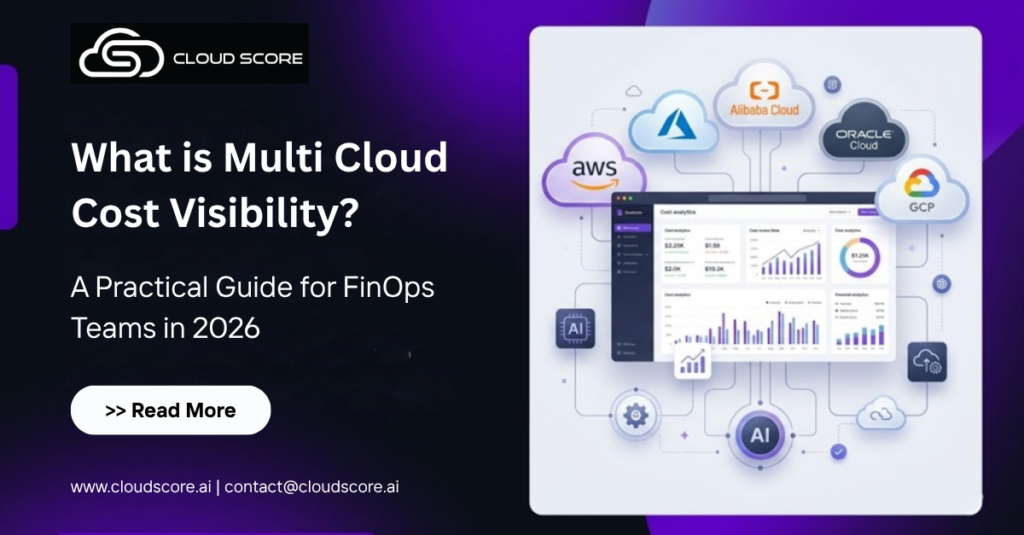
Multi Cloud Cost Visibility is becoming a critical priority for FinOps teams as organizations scale across AWS, Azure, and GCP. Without a unified view of cloud spending, businesses face rising costs, poor accountability, and limited control over their infrastructure.
In 2026, managing cloud costs is no longer just about tracking bills – it’s about gaining real-time visibility, enforcing governance, and driving continuous optimization.
This guide will help FinOps teams understand how to implement multi cloud cost visibility and turn cloud spending into a strategic advantage.
What is Multi Cloud Cost Visibility?
Multi Cloud Cost Visibility refers to the ability to track, analyze, and understand cloud spending across multiple cloud providers in a single unified view.
Instead of managing separate dashboards, FinOps teams can:
- Monitor costs across AWS, Azure, and GCP
- Allocate spending to teams, projects, or environments
- Identify inefficiencies and cost anomalies
- Make data-driven financial decisions
👉 The goal is simple:
Gain complete transparency to enable better cost control and optimization.
Why FinOps Teams Struggle Without Visibility
1. Fragmented Billing Systems
Each cloud provider uses different pricing models and reporting formats.
2. Lack of Cost Allocation
Without tagging and structure:
- Costs cannot be mapped accurately
- Accountability is lost
3. Limited Native Tools
Default cloud tools:
- Work in silos
- Lack cross-cloud insights
4. Rapid Infrastructure Growth
As cloud usage scales:
- Costs increase unpredictably
- Waste goes unnoticed
👉 Result: Finance loses control, engineering lacks clarity
How to Achieve Multi Cloud Cost Visibility with CloudScore
1. Centralized Cost Dashboard
Use a unified platform to:
- Combine AWS, Azure, and GCP billing data
- View all costs in one place
2. Implement a Tagging Strategy
Tag resources based on:
- Teams
- Projects
- Environments (Dev, Test, Prod)
👉 This ensures accurate cost allocation
3. Enable Real-Time Monitoring
Set up:
- Live dashboards
- Cost anomaly alerts
👉 Detect unusual spending instantly
4. Cost Allocation & Reporting
Break down costs by:
- Business units
- Applications
- Customers
👉 This is essential for FinOps maturity
How to Control Cloud Spend
Budgeting & Alerts
Define spending thresholds and get notified when limits are exceeded.
Rightsizing Resources
Match resources to actual usage and eliminate over-provisioning.
Remove Idle Resources
Identify and shut down unused instances and storage.
Optimize Commitments
Use reserved instances and savings plans for predictable workloads.
👉 These steps can reduce costs by 20–30%
How to Optimize Cloud Costs in 2026
AI-Driven Insights
Modern platforms provide:
- Cost anomaly detection
- Predictive cost forecasting
- Intelligent recommendations
Automation
Automation helps:
- Continuously optimize resources
- Reduce manual effort
- Improve efficiency
Continuous Optimization
Optimization is not one-time.
👉 It must be:
- Ongoing
- Data-driven
- Automated
Tools for Multi Cloud Cost Visibility
FinOps teams typically use:
- Native cloud dashboards
- Third-party cost management tools
However, most tools:
- Lack unified visibility
- Provide limited automation
- Focus only on cost, not governance
👉 Modern platforms combine FinOps + governance + intelligence to deliver better outcomes.
The Future: Unified FinOps + Governance
The next evolution is clear:
👉 Unified platforms that combine cost visibility, optimization, and governance
These platforms enable:
- Real-time cost tracking
- AI-driven optimization
- Compliance and security insights
- Cross-team accountability
Key Benefits of Multi Cloud Cost Visibility
- Complete transparency across cloud environments
- Reduced cloud waste
- Better forecasting and budgeting
- Improved operational efficiency
- Strong governance and compliance
Multi-cloud environments bring flexibility, but without visibility, they create financial complexity.
FinOps teams that succeed in 2026 will:
- Track costs in real time
- Control spending proactively
- Optimize continuously with AI
👉 Multi Cloud Cost Visibility is no longer optional – it’s a competitive advantage.
Start controlling your cloud costs with CloudScore gain full multi-cloud visibility today.
 Request a Demo | Start Your Free Trial | Contact Our Experts
See More Blogs: Cloud Cost Optimization Platform | CloudOps Cost Optimization | Cloud Security Posture Management | Cloud Intelligence Platform | DevOps Environment Sprawl | FinOps Cloud Cost Ownership | FinOps and SecOps Convergence | DevOps Cloud Cost Visibility | Code Scan | Power Schedules | Multi Cloud Cost Optimization | Untagged Cloud Resources | Best Cloud Governance Solutions | SecOps & FinOps Cloud Governance | AI-Driven FinOps | AI Cloud Cost Optimization | Smart Cost Management | Simplify Cloud Costs | Automated FinOps Platform | Multi-Cloud Spend | Cost Efficiency | Cloud Security | Dynamic Optimization | Seasonality Insights | Cloud Governance | Sustainability Reporting | Cloud Infrastructure | Predictive Analytics | Integrating FinOps | Forecasting | Automated Cost Management | Cloud Cost Optimization