
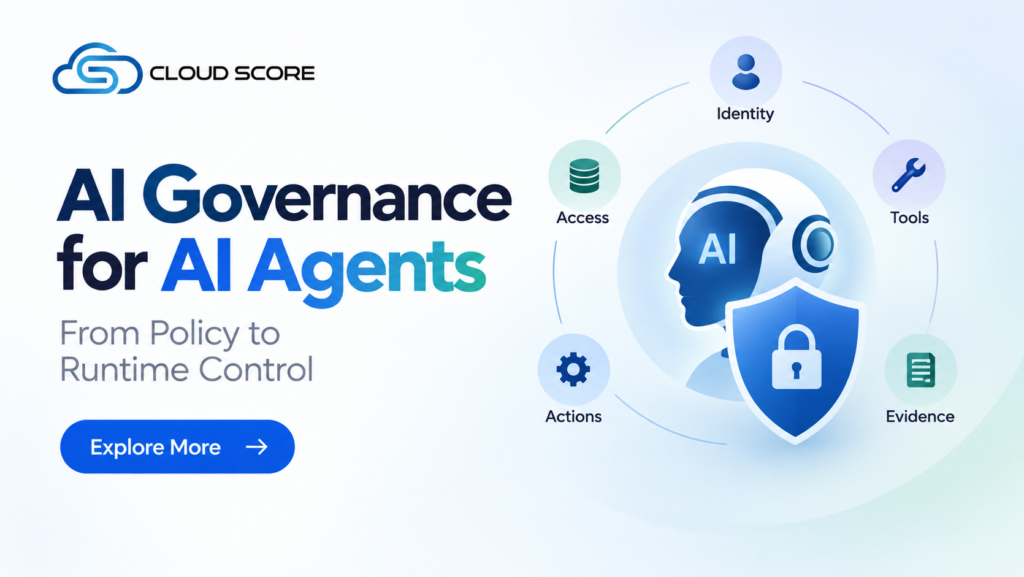
AI Governance is entering a new phase.
As enterprises move from AI assistants and copilots toward AI agents, the challenge is no longer only about approving models or reviewing AI-generated outputs.
A traditional AI model generates an answer.
An AI agent can take an action.
It can analyze information, call APIs, interact with business applications, access data, trigger workflows, and operate across connected systems.
That creates a more important enterprise question:
What is the AI agent allowed to do, and how can the organization keep that under control as the environment changes?
This is where modern AI Governance becomes operational.
What Makes AI Agent Governance Different?
Traditional governance often focuses on model approval, risk assessment, data protection, responsible use, and compliance.
AI agents add another dimension: autonomy.
An agent may have:
An identity
Data access
API permissions
Connected tools
Application access
Cloud resources
The ability to perform actions
The model is therefore only one part of the governance picture.
An enterprise also needs to understand:
Who is using the agent?
What can it access?
Which tools can it use?
What actions can it perform?
What happens when the environment changes?
This shifts the focus from simply governing the model to governing the agent, its capabilities, and its actions.
The Shift From Model Governance to Action Governance
Imagine an AI agent originally designed to analyze customer information.
Later, it receives permission to update customer records.
The business use case may look almost identical.
The governance risk is not.
A stronger approach therefore considers:
Model + Agent + Identity + Data + Tools + Permissions + Actions
This gives enterprises a more complete view of how AI operates inside the business.
The important question becomes:
Is the agent operating within the boundaries it was originally approved for?
The 5 Core Areas of AI Agent Governance
1. Identity
Every AI agent should have a clearly defined identity.
Organizations should be able to determine which agent is acting, which application initiated the activity, and which user or workflow is behind the request.
Clear identity makes accountability possible.
2. Access
An agent should only have access to the information and systems required for its intended purpose.
That may include:
Enterprise data
Internal documents
Databases
Applications
APIs
Cloud resources
The principle is simple:
Give the agent the access it needs-not the access it might eventually need.
3. Tools
Tools turn an AI model into an operational system.
An agent may connect to APIs, databases, search services, cloud platforms, internal applications, or automation tools.
Each connection expands its capabilities.
Each capability becomes another governance point.
4. Actions
Not every action has the same impact.
Analyzing information is different from modifying it.
Updating a record is different from changing a production workload.
Sending a recommendation is different from executing a transaction.
A mature governance model should therefore define:
Which actions are allowed?
Which actions require approval?
Which actions should never be automated?
5. Evidence
Organizations need to understand what happened.
What did the agent analyze?
Which tools did it use?
What did it change?
Which decision did it make?
What triggered the action?
Good governance creates enough evidence to make important AI activity understandable and accountable.
Governance Must Continue After Deployment
One of the biggest mistakes an enterprise can make is treating governance as a one-time approval.
Environments change constantly.
Models change.
Permissions change.
Applications change.
Tools are added.
Cloud resources scale.
Workflows evolve.
Costs change.
Agent behavior can change as its surrounding context changes.
This makes runtime governance increasingly important.
Organizations need to identify meaningful changes such as:
New permissions
New tool connections
Changes in agent scope
Unusual activity
Unexpected data access
Policy violations
Infrastructure changes
Cost increases
Dependency changes
The objective is not to monitor every event equally.
It is to identify changes that could materially affect risk, behavior, cost, reliability, or business impact.
That turns governance from a document into a continuous operating practice.
AI Governance and Cloud Environments
AI agents rarely operate alone.
A typical enterprise workflow may look like:
Agent → Application → API → Database → Cloud Infrastructure
A problem anywhere in that chain can affect the AI workload.
A change in infrastructure can affect reliability.
A change in permissions can affect access.
A change in cloud consumption can affect cost.
A change in a connected service can affect the agent’s ability to complete a task.
This means an effective governance approach needs context across:
AI + Applications + Data + Infrastructure + Cost + Operations
The more connected the agent becomes, the more important that context becomes.
AI Agent Governance and Cost Control
AI Governance is not only about permissions and accountability.
Agentic workloads can create complex consumption across:
Model inference
LLM usage
APIs
GPUs
Compute
Databases
Vector stores
Networking
Cloud services
That leads to a practical question:
What does one successful AI workflow actually cost?
The answer may involve much more than the model itself.
It can include tool calls, repeated context, infrastructure consumption, data retrieval, and multiple model interactions.
That makes efficiency an important part of responsible AI operations.
Token Optimization
Efficient token usage matters because repeated context, oversized prompts, and unnecessary model calls can increase AI consumption. AI Governance should include visibility into token usage and encourage efficient model and prompt usage.
Cache Management
Appropriate caching can reduce repeated processing and unnecessary model calls. AI Governance should ensure cached data remains subject to the right privacy, access, and retention controls.
Governing Agent Permissions and Actions
An agent’s capabilities should match its approved purpose.
An agent that can analyze information does not automatically need permission to modify records.
An agent that can update an application may not need access to unrelated systems.
A practical framework should define:
What the agent can access
What tools it can use
What actions it can perform
Which actions require approval
What happens when it exceeds its permitted scope
This makes autonomy measurable instead of ambiguous.
The objective is not to prevent useful automation.
It is to make sure that autonomous actions happen within clearly defined boundaries.
When an AI Agent Fails, the Model May Not Be the Problem
An AI-powered application can fail even when the model itself is functioning normally.
The cause might be:
API timeout
Database latency
Authentication failure
Network configuration
Cloud capacity
Deployment change
Dependency failure
Infrastructure instability
This is why AI observability needs more than model evaluation.
Teams need to understand the larger chain:
Agent → Application → API → Infrastructure → Dependency
Instead of asking only:
“Did the model respond?”
the better operational question is:
“Why did the workflow fail?”
That distinction matters when AI becomes part of business-critical processes.
From AI Governance to AI Control
The next stage of enterprise governance is not simply writing more policies.
It is turning policy into measurable control.
A useful framework can be built around four stages:
Know
Identify the AI systems and agents operating across the organization.
Understand
Understand their owners, data, tools, permissions, dependencies, cost, and business purpose.
Control
Apply appropriate boundaries to access, actions, environments, and risk.
Prove
Maintain evidence of what was approved, what changed, what the agent did, and who was accountable.
This creates a continuous loop:
Know → Understand → Control → Prove
A Practical AI Governance Model
A practical enterprise program should be able to answer five questions.
What exists?
Can the organization identify its AI applications, models, and agents?
What can they do?
Are their tools, permissions, data access, and actions clearly defined?
What changed?
Can meaningful changes to models, permissions, tools, infrastructure, and behavior be identified?
What is the impact?
Can the organization understand the effect on risk, cost, reliability, and business operations?
Can we prove it?
Is there enough evidence to explain what happened and who was responsible?
When these questions can be answered continuously, governance becomes part of how the enterprise operates AI rather than a separate compliance exercise.
The New Enterprise Question
The old question was:
“Is our AI compliant?”
The next question is:
“Do we know what our AI is doing?”
The more important question is:
“Can we control what it is allowed to do as its environment changes?”
That is where modern AI Governance is heading.
Not just policy.
Not just model approval.
Not just compliance.
Visibility.
Boundaries.
Runtime control.
Accountability.
The Future of AI Governance Is Runtime-Aware
AI will continue moving from assistants to copilots, agents, and increasingly autonomous systems.
Governance has to evolve at the same pace.
The strongest enterprise programs will not necessarily be the ones with the longest governance documents.
They will be the ones that can continuously answer:
What AI exists?
What can it access?
What can it do?
What changed?
What does it cost?
What is the impact?
Who is accountable?
Can we intervene?
That is the next chapter of AI Governance.
The goal is not to make AI less capable.
It is to make increasingly capable AI more understandable, more controllable, and more accountable.
As AI agents become part of everyday enterprise operations, that ability to govern actions-not just models-will become one of the foundations for scaling AI with confidence.
Govern AI agents with visibility, control, and confidence. Explore how CloudScore helps you bring AI governance into runtime.
 Request a Demo | Start Your Free Trial | Contact Our Experts
See More Blogs: Governance | AI Cloud Cost Recommendations | AI FinOps Assistant | Cloud Cost Governance | Multi Cloud Management Platform | Multi Cloud Financial Management | AI-Powered FinOps Platform | Cloud Cost Anomaly Detection Platform | Cloud Cost Reduction | Multi Cloud Cost Intelligence | Multi Cloud Cost Visibility | Cloud Cost Optimization Platform | CloudOps Cost Optimization | Cloud Security Posture Management | Cloud Intelligence Platform | DevOps Environment Sprawl | FinOps Cloud Cost Ownership | FinOps and SecOps Convergence | DevOps Cloud Cost Visibility | Code Scan | Power Schedules | Multi Cloud Cost Optimization | Untagged Cloud Resources | Best Cloud Governance Solutions | SecOps & FinOps Cloud Governance | AI-Driven FinOps | AI Cloud Cost Optimization | Smart Cost Management | Simplify Cloud Costs | Automated FinOps Platform | Multi-Cloud Spend | Cost Efficiency | Cloud Security | Dynamic Optimization | Seasonality Insights | Cloud Governance | Sustainability Reporting | Cloud Infrastructure | Predictive Analytics | Integrating FinOps | Forecasting | Automated Cost Management | Cloud Cost Optimization