
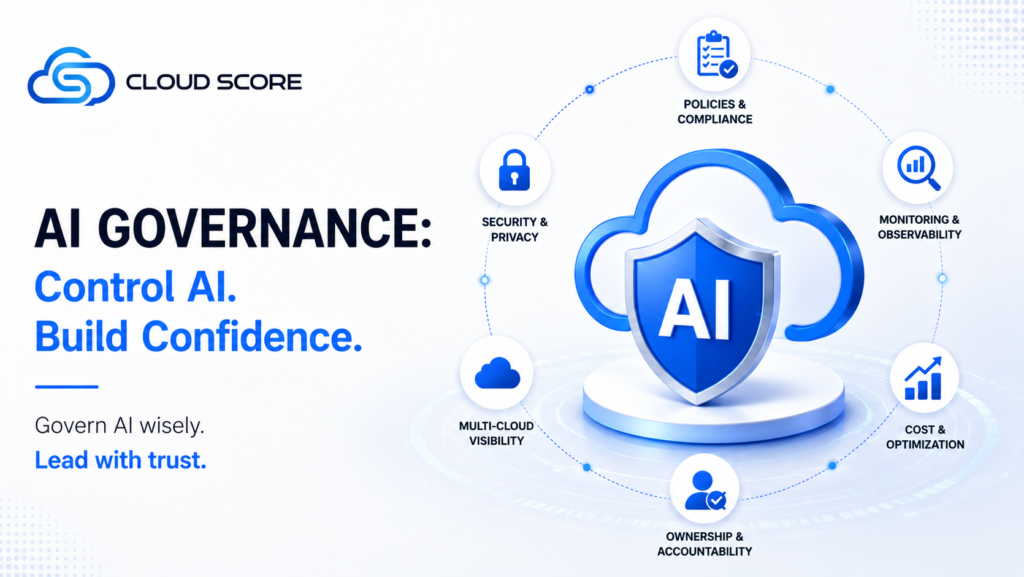
AI Governance is becoming essential as artificial intelligence moves from experimentation into everyday enterprise operations. Organizations are using AI to automate business processes, assist employees, analyze large volumes of data, generate content, support software development, improve customer experiences, and make faster decisions.
Generative AI and AI agents are accelerating this transformation even further.
But as AI becomes more deeply connected to enterprise applications, cloud infrastructure, business data, and operational workflows, organizations face a critical challenge:
How do enterprises scale AI without losing visibility, security, accountability, or control?
That is where AI Governance becomes essential.
AI Governance provides enterprises with a structured framework for managing how artificial intelligence is developed, deployed, accessed, monitored, secured, governed, and optimized throughout its lifecycle.
The objective is not to restrict AI innovation.
The objective is to create an environment where enterprises can adopt AI confidently, responsibly, securely, and at scale.
What Is AI Governance?
AI Governance is the framework of policies, processes, controls, technologies, and responsibilities used to manage artificial intelligence throughout its lifecycle.
A practical AI Governance framework helps organizations answer fundamental questions such as:
- What AI systems are being used?
- Which AI models are approved?
- Where are AI applications deployed?
- Who owns each AI workload?
- What enterprise data can AI access?
- Which users and applications can access AI services?
- Are AI systems operating according to organizational policies?
- How are AI risks identified and managed?
- How much do AI workloads cost?
- Are AI services performing reliably?
- Can AI-related decisions and actions be audited?
Without this visibility, AI adoption can quickly become difficult to manage.
Why Do Enterprises Need AI Governance Now?
Enterprise AI adoption is happening faster than traditional governance processes were designed to handle.
A few years ago, AI initiatives were often limited to specialized data science teams.
Today, AI can be introduced almost anywhere.
Developers can integrate an LLM through an API.
Business teams can adopt AI-powered SaaS applications.
Engineering teams can deploy AI agents.
Employees can use generative AI assistants.
Organizations can build AI applications using multiple model providers and cloud platforms.
This creates a highly distributed AI ecosystem.
An enterprise may soon have hundreds of AI-enabled applications, models, APIs, agents, datasets, and infrastructure components operating simultaneously.
Without effective AI Governance, organizations can lose visibility into:
What AI exists, who is using it, what it can access, what it costs, and what risks it introduces.
The New Enterprise AI Governance Challenge
AI introduces challenges that extend beyond the AI model itself.
Consider a typical enterprise AI application.
It may involve:
Users
↓
Applications
↓
AI Agents
↓
LLMs / AI Models
↓
APIs
↓
Enterprise Data
↓
Databases
↓
Cloud Infrastructure
↓
Networks, Compute, Storage and Security Controls
Each layer introduces its own risks and operational dependencies.
An AI application may be secure at the model layer but expose sensitive information through an improperly configured API.
An AI workload may work correctly but generate unexpectedly high cloud or inference costs.
An AI agent may have excessive permissions.
A model may depend on an infrastructure service experiencing performance degradation.
This is why Enterprise AI Governance must look beyond individual models.
It must consider the complete AI ecosystem, including applications, models, agents, data, APIs, infrastructure, security, cost, and operational dependencies.
What Are the Core Pillars of Enterprise AI Governance?
A strong AI Governance framework should address several interconnected areas.
- AI Visibility
Enterprises cannot govern what they cannot see.
Organizations need an inventory of their AI ecosystem, including:
- AI applications
- AI models
- AI agents
- APIs
- Data sources
- Cloud services
- Infrastructure
- Model providers
- Owners
- Business functions
Visibility creates the foundation for every other governance capability.
The first question of AI Governance should therefore be:
What AI are we currently using?
- AI Ownership and Accountability
Every enterprise AI system should have clear ownership.
Organizations should understand:
- Who owns the AI application?
- Which business unit uses it?
- Who is responsible for the model?
- Who owns the underlying infrastructure?
- Who approves access?
- Who responds when something goes wrong?
Clear ownership prevents AI systems from becoming unmanaged technology assets.
It also ensures that accountability exists throughout the AI lifecycle.
- Data Governance and Privacy
AI systems often depend heavily on enterprise data.
That data may include:
- Customer information
- Financial records
- Employee information
- Intellectual property
- Operational data
- Source code
- Documents
- Internal communications
AI Governance should define what information AI systems are allowed to access and how that information can be processed.
Organizations need controls around:
- Data classification
- Data access
- Data residency
- Sensitive information
- Retention
- Model training
- Prompt data
- AI-generated output
The fundamental principle should be:
AI should only access the data required for its intended business purpose.
- AI Security
AI systems introduce new attack surfaces alongside traditional cloud and application security risks.
Enterprises need security controls across:
- Identity
- Access permissions
- Models
- APIs
- Applications
- AI agents
- Infrastructure
- Networks
- Data
AI agents require particular attention because they may be capable of interacting with enterprise systems or automatically performing actions.
AI Governance should ensure that AI receives:
The right access, to the right resources, for the right purpose, under the right controls.
- AI Risk Management
Not every AI application carries the same level of risk.
For example, an internal meeting-summary assistant may have relatively limited business impact.
An AI system supporting decisions within a critical financial or healthcare process may require substantially greater oversight.
Organizations should therefore classify AI systems according to factors such as:
- Business impact
- Data sensitivity
- User exposure
- Autonomy
- Decision-making capability
- Regulatory requirements
- Infrastructure dependency
- Financial exposure
This allows enterprises to apply stronger governance controls to higher-risk AI workloads.
A risk-based AI Governance strategy ensures that governance effort is aligned with the potential impact of each AI system.
- AI Model Governance
Enterprises may eventually use dozens or even hundreds of AI models.
These models may come from different providers and serve different purposes.
Organizations need visibility into:
- Which models are being used
- Why each model was selected
- Model versions
- Model ownership
- Performance
- Accuracy
- Cost
- Usage
- Approved use cases
- Data access
Model governance becomes particularly important as organizations begin dynamically selecting models based on workload requirements, performance, security, latency, and cost.
The most powerful model is not always the most appropriate model.
Enterprise AI Governance should help determine the:
Right model for the right workload.
- AI Cost Governance
AI can introduce significant and sometimes unpredictable costs.
Enterprise AI spending may include:
- LLM tokens
- Model inference
- GPUs
- Compute
- Storage
- Databases
- Vector databases
- Networking
- AI APIs
- Managed AI services
Without visibility, AI experimentation can quickly turn into uncontrolled AI spending.
Organizations therefore need to understand:
Which team is consuming AI resources?
Which application is generating the cost?
Which model is being used?
How much does each AI workload cost?
Can a lower-cost model deliver the same business result?
This is where AI Governance begins to connect with FinOps and cloud economics.
Effective AI cost governance helps enterprises understand consumption, ownership, optimization opportunities, and the relationship between AI spending and business value.
- AI Reliability and Operational Governance
AI systems are becoming part of business-critical applications.
They therefore need to be monitored like any other enterprise workload.
Organizations should understand:
- Is the AI service available?
- Is latency increasing?
- Are model requests failing?
- Are dependencies healthy?
- Has infrastructure usage changed?
- Is an external AI provider experiencing issues?
- Has application behavior changed after a deployment?
AI Governance therefore cannot end once an AI application is approved.
Governance must continue while the application is running.
This connects AI Governance with SRE, observability, and AI-SRE.
- Compliance and Auditability
Enterprises need the ability to demonstrate how AI systems are governed.
Depending on industry and geography, organizations may need documentation around:
- AI ownership
- Risk classification
- Model selection
- Data access
- Policies
- Approvals
- Security controls
- Operational changes
- AI-generated decisions
- Audit history
AI Governance should therefore create an auditable record of how AI systems are being managed.
Governance cannot depend entirely on spreadsheets, emails, and periodic reviews as AI adoption scales.
A mature approach makes governance more continuous, measurable, and operational.
- Human Oversight
AI is becoming more autonomous.
AI agents can increasingly:
- Analyze information
- Make recommendations
- Execute workflows
- Call APIs
- Update systems
- Trigger infrastructure actions
Enterprises need to define where AI can act independently and where human approval is required.
A strong AI Governance model should support:
AI-assisted decisions where appropriate.
Human approval for high-impact actions.
This approach allows enterprises to benefit from automation without giving up operational control.
The Enterprise AI Governance Lifecycle
AI Governance should not be treated as a one-time approval process.
It should operate continuously throughout the AI lifecycle.
A practical AI Governance lifecycle is:
Discover → Assess → Approve → Deploy → Monitor → Govern → Optimize
Discover
Identify AI applications, models, agents, APIs, data, infrastructure, and ownership.
Assess
Evaluate security, privacy, cost, operational, and business risks.
Approve
Apply appropriate policies, access controls, and governance requirements.
Deploy
Release AI workloads within approved enterprise environments.
Monitor
Continuously observe security, cost, performance, usage, and infrastructure behavior.
Govern
Identify policy violations, risks, ownership gaps, and unexpected behavior.
Optimize
Improve models, infrastructure, costs, security controls, and operational performance.
Governance therefore becomes a continuous operating model rather than a periodic compliance activity.
How Does AI Governance Work Across Multi-Cloud Environments?
Enterprise AI rarely operates within a single platform.
Organizations may use:
AWS
Microsoft Azure
Google Cloud
Kubernetes
Private cloud
SaaS AI platforms
Third-party model providers
Different business units may adopt different technologies.
Different applications may use different models.
Different regions may have different data and compliance requirements.
The objective of enterprise AI Governance should therefore not be to force every workload onto the same platform.
The objective should be to establish consistent governance principles across a diverse technology environment.
Regardless of platform, organizations should be able to answer:
- What AI systems exist?
- Where are they running?
- What can they access?
- Who owns them?
- Are they secure?
- Are they compliant?
- Are they reliable?
- What do they cost?
A multi-cloud AI Governance approach helps organizations establish consistent visibility and control without requiring every AI workload to use the same technology stack.
AI Governance Is More Than Compliance
AI Governance is sometimes viewed primarily as a regulatory requirement.
That is only one part of the story.
Effective governance can provide significant business benefits.
It can help organizations:
Accelerate AI Adoption
Clear policies reduce uncertainty for development and business teams.
Improve Security
AI access and infrastructure risks become more visible.
Control AI Spending
Organizations gain better visibility into model and infrastructure costs.
Reduce Operational Risk
AI workloads can be continuously monitored rather than reviewed only before deployment.
Improve Accountability
AI ownership and responsibilities become clear.
Enable Automation
Organizations can safely introduce AI agents and automated workflows within defined guardrails.
Build Trust
Employees, customers, security teams, and executives gain greater confidence in how AI is being used.
Governance therefore becomes an enabler of AI adoption rather than a barrier to innovation.
From AI Governance to AI Operations
As enterprise AI adoption matures, governance will increasingly connect with operational disciplines.
Three areas will become particularly important:
FinOps
Understanding AI infrastructure consumption, model costs, optimization opportunities, ownership, and business value.
SecOps
Protecting AI applications, infrastructure, identities, APIs, and enterprise data.
AI-SRE
Monitoring AI workloads, understanding infrastructure dependencies, investigating incidents, and improving reliability.
Together, these capabilities can turn AI Governance from a policy framework into a continuous enterprise operating model.
The evolution becomes:
AI Visibility → AI Governance → AI Security → AI Operations → AI Optimization
This evolution reflects a broader shift from simply approving AI systems to continuously understanding, protecting, operating, and optimizing them.
Where CloudScore Fits
CloudScore supports the operational layer surrounding modern enterprise cloud and AI workloads.
As AI applications become increasingly dependent on cloud infrastructure, enterprises need visibility not only into AI models but also into the environments supporting them.
CloudScore’s capabilities across areas such as:
- Multi-cloud visibility
- FinOps
- Cloud economics
- SecOps
- Infrastructure discovery
- Governance
- Infrastructure topology
- AI-SRE
can help enterprises build greater operational context around their cloud and AI environments.
The objective is not to replace an organization’s AI Governance policies.
It is to provide the cloud intelligence required to operationalize those policies.
As enterprises scale AI across cloud environments, this operational intelligence can help connect governance requirements with infrastructure, security, financial, and reliability context.
The Future of Enterprise AI Governance
AI Governance will continue to evolve as AI becomes more capable.
Enterprises are moving from:
AI Assistants
to
AI Copilots
to
AI Agents
and eventually toward increasingly autonomous AI systems.
Governance models must evolve at the same pace.
Future AI Governance will increasingly become:
Continuous
AI systems will be governed throughout their lifecycle rather than assessed only at deployment.
Automated
Routine policy and configuration checks will be evaluated automatically.
Context-Aware
Governance decisions will consider data, infrastructure, security, cost, applications, and business impact together.
Risk-Based
Controls will be applied according to the potential impact of each AI workload.
Multi-Cloud
Organizations will govern AI consistently across multiple technology environments.
Operational
FinOps, SecOps, observability, and AI-SRE will become part of the governance ecosystem.
Human-Controlled
AI may become increasingly autonomous, while high-impact actions remain governed by enterprise policy and human oversight.
The future of AI Governance will therefore be less about periodic approval and more about continuous intelligence, control, accountability, and optimization.
AI Governance Creates the Confidence to Scale AI
The question for enterprises is no longer:
Should we adopt AI?
AI adoption is already happening.
The more important question is:
How do we scale AI responsibly without losing control?
Organizations need visibility into:
What AI they are using.
Who owns it.
What data it can access.
Whether it is secure.
How reliably it operates.
What it costs.
Whether it delivers business value.
AI Governance creates the framework required to answer those questions.
As AI becomes more deeply connected with enterprise cloud environments, governance will increasingly depend on financial, security, and operational intelligence.
The organizations that build these capabilities today will be better prepared for an AI-driven future.
Because successful enterprise AI will not be defined only by how powerful the AI becomes.
It will also be defined by how intelligently the enterprise governs it.
 Request a Demo | Start Your Free Trial | Contact Our Experts
See More Blogs: AI Cloud Cost Recommendations | AI FinOps Assistant | Cloud Cost Governance | Multi Cloud Management Platform | Multi Cloud Financial Management | AI-Powered FinOps Platform | Cloud Cost Anomaly Detection Platform | Cloud Cost Reduction | Multi Cloud Cost Intelligence | Multi Cloud Cost Visibility | Cloud Cost Optimization Platform | CloudOps Cost Optimization | Cloud Security Posture Management | Cloud Intelligence Platform | DevOps Environment Sprawl | FinOps Cloud Cost Ownership | FinOps and SecOps Convergence | DevOps Cloud Cost Visibility | Code Scan | Power Schedules | Multi Cloud Cost Optimization | Untagged Cloud Resources | Best Cloud Governance Solutions | SecOps & FinOps Cloud Governance | AI-Driven FinOps | AI Cloud Cost Optimization | Smart Cost Management | Simplify Cloud Costs | Automated FinOps Platform | Multi-Cloud Spend | Cost Efficiency | Cloud Security | Dynamic Optimization | Seasonality Insights | Cloud Governance | Sustainability Reporting | Cloud Infrastructure | Predictive Analytics | Integrating FinOps | Forecasting | Automated Cost Management | Cloud Cost Optimization