
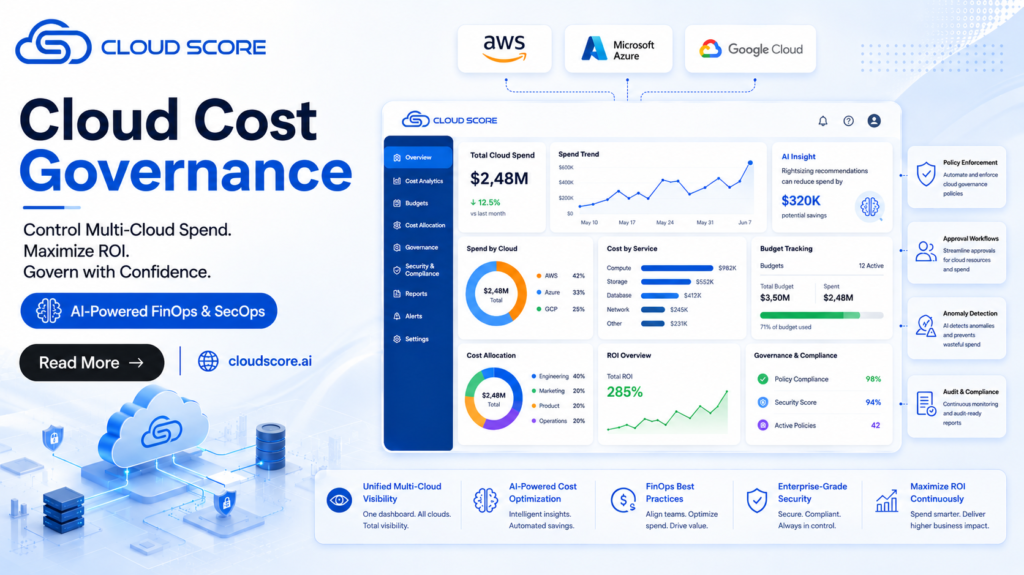
Cloud Cost Governance has become a critical priority for enterprises operating across AWS, Azure, Google Cloud, and Kubernetes environments. As organizations accelerate cloud adoption, cloud spending continues to grow, often faster than expected. Without a structured governance framework, businesses face cost overruns, resource sprawl, budget uncertainty, and reduced return on cloud investments. Cloud Cost Governance provides the policies, visibility, accountability, and automation needed to control multi-cloud spending while maximizing business value.
Why Cloud Spending Continues to Rise
Many organizations invest heavily in cloud transformation expecting greater agility, scalability, and innovation. While these benefits are real, cloud environments often become difficult to manage as infrastructure expands.
Common challenges include:
- Unused or underutilized resources
- Lack of cost ownership across teams
- Overprovisioned workloads
- Inefficient cloud architectures
- Limited visibility into spending trends
- Uncontrolled Kubernetes costs
- Inconsistent tagging and allocation practices
As cloud environments grow, even small inefficiencies can result in significant financial waste. Enterprises need a governance strategy that balances innovation with financial accountability.
What Is Cloud Cost Governance?
Cloud Cost Governance is the framework of policies, processes, controls, and technologies used to monitor, manage, and optimize cloud spending across an organization.
It enables enterprises to:
- Gain complete visibility into cloud costs
- Establish accountability across teams
- Allocate costs accurately
- Monitor budgets proactively
- Identify waste and inefficiencies
- Optimize resource utilization
- Improve forecasting accuracy
- Align cloud investments with business goals
Unlike traditional cost management, Cloud Cost Governance creates an ongoing discipline that combines financial management, operational excellence, and strategic decision-making.
The Core Pillars of Cloud Cost Governance
1. Visibility and Cost Transparency
Organizations cannot optimize what they cannot see.
Comprehensive visibility provides:
- Real-time cloud spend monitoring
- Service-level cost breakdowns
- Business-unit cost allocation
- Departmental chargeback reporting
- Multi-cloud cost aggregation
When teams understand where cloud budgets are being spent, they can make informed optimization decisions.
2. Accountability and Ownership
Successful governance requires clear ownership.
Organizations should assign responsibility for cloud spending to:
- Engineering teams
- DevOps teams
- Platform teams
- Business units
- Finance stakeholders
Cost ownership encourages teams to make cloud-efficient decisions without compromising performance.
3. Policy-Based Governance
Governance policies establish spending controls across cloud environments.
Examples include:
- Resource provisioning standards
- Budget thresholds
- Automated approval workflows
- Tagging requirements
- Resource lifecycle policies
These controls reduce unnecessary spending while maintaining operational flexibility.
4. Cost Allocation and Chargeback
Accurate cost allocation helps organizations understand cloud consumption patterns.
Benefits include:
- Department-level accountability
- Project-based budgeting
- Improved financial planning
- Better forecasting accuracy
- Transparent cost reporting
Cost allocation transforms cloud expenses from a shared burden into measurable business investments.
5. Continuous Optimization
Cloud environments are constantly changing.
Continuous optimization involves:
- Rightsizing resources
- Eliminating idle infrastructure
- Optimizing storage usage
- Managing reserved instances
- Improving Kubernetes efficiency
- Identifying cost anomalies
Optimization should be an ongoing process rather than a periodic exercise.
Multi-Cloud Governance Challenges
Managing a single cloud platform is complex. Managing multiple cloud providers introduces additional challenges.
Organizations often struggle with:
- Different pricing models
- Separate billing structures
- Fragmented reporting systems
- Inconsistent governance policies
- Limited visibility across platforms
- Compliance management complexity
Without centralized governance, multi-cloud environments can become difficult to control and expensive to operate.
How AI Is Transforming Cloud Cost Governance
Artificial intelligence is changing how enterprises manage cloud spending.
AI-powered governance solutions help organizations:
- Detect anomalies automatically
- Forecast future spending
- Identify optimization opportunities
- Recommend cost-saving actions
- Automate policy enforcement
- Improve budget planning
Instead of reacting to overspending after it occurs, organizations can proactively prevent financial inefficiencies.
The Connection Between FinOps and Cloud Cost Governance
FinOps and Cloud Cost Governance work together to create a sustainable cloud operating model.
FinOps focuses on:
- Financial accountability
- Cost visibility
- Business alignment
- Cross-functional collaboration
Cloud Cost Governance provides the structure needed to support these objectives through policies, controls, automation, and operational processes.
Together, they help enterprises maximize the value of every cloud dollar spent.
Best Practices for Building a Cloud Cost Governance Framework
Organizations looking to strengthen governance should:
Establish Clear Governance Policies
Define standards for resource provisioning, tagging, budgeting, and lifecycle management.
Implement Comprehensive Cost Visibility
Consolidate spending data across AWS, Azure, Google Cloud, and Kubernetes environments.
Assign Cost Ownership
Create accountability across engineering, operations, and business teams.
Automate Governance Workflows
Reduce manual effort through policy-driven automation.
Monitor Continuously
Track spending trends, anomalies, and optimization opportunities in real time.
Align Costs With Business Outcomes
Measure cloud investments based on business value rather than infrastructure consumption alone.
How CloudScore Simplifies Cloud Cost Governance
CloudScore provides enterprises with a unified platform for FinOps, Cloud Intelligence, and SecOps.
With CloudScore, organizations can:
- Gain multi-cloud cost visibility
- Monitor cloud spending in real time
- Automate governance policies
- Improve cost allocation accuracy
- Detect anomalies proactively
- Optimize Kubernetes and cloud workloads
- Strengthen compliance and security posture
- Maximize cloud ROI through AI-powered insights
By combining cost intelligence, governance, automation, and security visibility, CloudScore helps enterprises transform cloud spending from a challenge into a competitive advantage.
As cloud environments become more complex, Cloud Cost Governance is no longer optional. Organizations that establish strong governance frameworks gain better visibility, stronger accountability, improved financial control, and greater business value from their cloud investments.
The future belongs to enterprises that can balance innovation with operational discipline. By implementing a comprehensive Cloud Cost Governance strategy and leveraging intelligent platforms like CloudScore, organizations can control multi-cloud spending, reduce waste, and maximize ROI across every cloud environment.
 Request a Demo | Start Your Free Trial | Contact Our Experts
See More Blogs: Multi Cloud Management Platform | Multi Cloud Financial Management | AI-Powered FinOps Platform | Cloud Cost Anomaly Detection Platform | Cloud Cost Reduction | Multi Cloud Cost Intelligence | Multi Cloud Cost Visibility | Cloud Cost Optimization Platform | CloudOps Cost Optimization | Cloud Security Posture Management | Cloud Intelligence Platform | DevOps Environment Sprawl | FinOps Cloud Cost Ownership | FinOps and SecOps Convergence | DevOps Cloud Cost Visibility | Code Scan | Power Schedules | Multi Cloud Cost Optimization | Untagged Cloud Resources | Best Cloud Governance Solutions | SecOps & FinOps Cloud Governance | AI-Driven FinOps | AI Cloud Cost Optimization | Smart Cost Management | Simplify Cloud Costs | Automated FinOps Platform | Multi-Cloud Spend | Cost Efficiency | Cloud Security | Dynamic Optimization | Seasonality Insights | Cloud Governance | Sustainability Reporting | Cloud Infrastructure | Predictive Analytics | Integrating FinOps | Forecasting | Automated Cost Management | Cloud Cost Optimization