
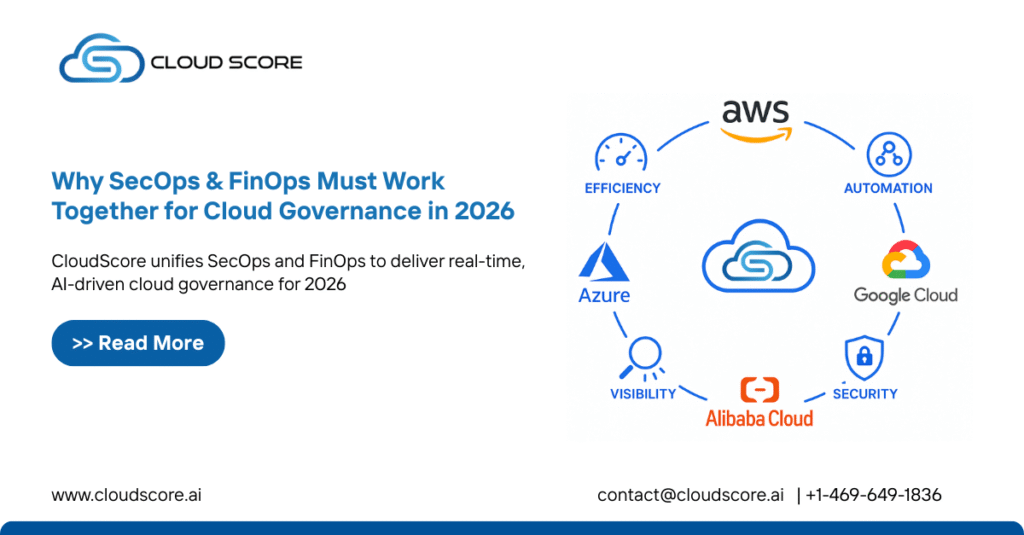
Cloud ecosystems are evolving at a pace that demands smarter, unified management. As organizations adopt multi-cloud, AI-driven workloads and high-speed deployments, SecOps & FinOps Cloud Governance 2026 becomes a critical priority. Security risks and cloud spending are no longer independent challenges they are interconnected. To maintain operational control, SecOps and FinOps must collaborate as a single discipline and platforms like CloudScore make this transformation seamless.
CloudScore unifies security posture, cost visibility, compliance automation and real-time cloud intelligence into one system. With automated guardrails, anomaly detection, and AI-driven recommendations, CloudScore helps organizations reduce risk, eliminate waste, and maintain continuous governance across multi-cloud environments.
The Cloud Challenges SecOps & FinOps Can’t Solve Alone
Modern cloud environments introduce challenges that neither team can tackle independently:
1. Rising Security Misconfigurations
Ephemeral workloads, open ports, IAM misuse, and untagged assets lead to security gaps often the same gaps that result in unnecessary spending.
CloudScore automatically detects these misconfigurations and maps them to cost impact, helping both teams prioritize what matters most.
2. Unpredictable Cloud Spend
AI tasks, data pipelines, auto-scaling clusters, and duplicate deployments can spike costs without warning.
CloudScore provides real-time visibility into cost anomalies, linking them to the resources or security risks behind them.
3. Increasing Compliance Burden
Manual compliance is impossible when workloads change every minute.
CloudScore enables policy-as-code enforcement, ensuring only compliant, secure, and cost-controlled deployments go live.
4. Limited Visibility Across Teams
Often, a cost spike is actually a security issue.
Or a security issue looks like normal usage.
CloudScore connects cost, performance and security signals into one shared system, giving both teams end-to-end clarity.
Why SecOps Needs FinOps And How CloudScore Bridges the Gap
SecOps teams are responsible for reducing risk but many risk indicators are cost signals.
CloudScore helps SecOps by:
- Detecting suspicious cost spikes that may indicate attacks
- Associating misconfigurations with potential financial impact
- Identifying unnecessary resources caused by excessive privileges or drift
- Highlighting risky deployments tied to increased spend
A more secure cloud is almost always a more cost-efficient cloud and CloudScore reveals that connection.
Why FinOps Needs SecOps – Powered by CloudScore
FinOps teams can’t optimize costs if the environment is insecure or ungoverned.
CloudScore supports FinOps by:
- Enforcing mandatory tagging for accurate cost allocation
- Blocking high-risk, high-cost resources via policy-as-code
- Flagging wasteful configurations caused by weak security
- Helping create budgets linked to risk and compliance tiers
CloudScore ensures financial governance is built on top of strong security foundations.
What Unified Cloud Governance Looks Like With CloudScore
When organizations use CloudScore to align SecOps and FinOps, they gain a governance model that’s automated, intelligent, and fully transparent.
Connected Insights
CloudScore displays security posture, cost metrics, and compliance status in a single unified dashboard.
Policy-as-Code Enforcement
Deployments violating security or cost rules are automatically blocked no manual approvals needed.
Real-Time Alerts
CloudScore sends notifications when cost anomalies or security risks appear.
Predictable Budgeting
Cost forecasts improve when they’re driven by security context.
Stronger Performance at Lower Cost
CloudScore fine-tunes resources based on both security requirements and cost-impact data.
This is governance built for modern cloud scale.
A Real-World Scenario: How CloudScore Enables Unified Governance
A global financial technology company operating across AWS and Azure faced several issues:
- Unexplained cost spikes
- Zero tagging consistency
- Over-permissioned IAM roles
- Frequent compliance failures
- SecOps and FinOps working in separate reporting tools
After adopting CloudScore, here’s how transformation happened:
Step 1: CloudScore Analyzed All Resources
CloudScore identified over-provisioned workloads, misconfigured networks, and excessive permissions causing both risk and cost leaks.
Step 2: CloudScore Enforced Tagging & IAM Policies
Resources missing required tags were blocked from deployment.
High-risk IAM permissions were automatically flagged and escalated.
Step 3: CloudScore Enabled Real-Time Cost & Risk Monitoring
Security alerts and cost spikes were correlated, detecting threats early and eliminating idle workloads.
Step 4: Results in 90 Days
- 30% reduction in cloud spend
- 60% fewer misconfigurations
- Complete cost attribution across teams
- Improved compliance pass rates
Unified governance became effortless.
Cloud Governance Built for 2026
CloudScore proves that the future of cloud operations is unified, not siloed.
When SecOps and FinOps work together:
- Compliance becomes continuous
- Costs become predictable
- Security improves across the board
- Cloud waste disappears
- Risks are caught earlier
- Deployments become safer and faster
With CloudScore as the central governance engine, organizations gain full visibility, automated controls, and intelligent optimization across all cloud environments.
In 2026, cloud excellence is defined by how well SecOps and FinOps collaborate and CloudScore is engineered to make that collaboration seamless.
 Request a Demo | Start Your Free Trial | Contact Our Experts
See More Blogs: AI-Driven FinOps | AI Cloud Cost Optimization | Smart Cost Management | Simplify Cloud Costs | Automated FinOps Platform | Multi-Cloud Spend | Cost Efficiency | Cloud Security | Dynamic Optimization | Seasonality Insights | Cloud Governance | Sustainability Reporting | Cloud Infrastructure | Predictive Analytics | Integrating FinOps | Forecasting | Automated Cost Management | Cloud Cost Optimization