
FinOps Has Data — But Still Loses Control
Most organizations today have some form of FinOps tooling. They track cloud spend, generate reports, and review budgets. Yet cloud costs continue to rise quarter after quarter.
The issue isn’t lack of data.
The issue is lack of ownership.
Cloud infrastructure is no longer static. Resources are created automatically through CI/CD pipelines, Terraform modules, Kubernetes controllers, and ephemeral environments. Manual tagging policies and spreadsheets simply cannot keep up with this pace.
When no one clearly owns a resource, no one feels responsible for its cost.
Why Traditional FinOps Models Break at Scale
Legacy FinOps assumes:
- Static resources
- Human-created infrastructure
- Finance-owned controls
- Monthly or quarterly reviews
Modern cloud environments break all of these assumptions.
In reality:
- Engineers create infrastructure automatically
- Kubernetes workloads share costs across teams
- Environments appear and disappear daily
- Budgets are exceeded before alerts fire
By the time finance notices an overrun, the context behind it is gone.
Ownership Is the Missing Layer in FinOps
Without real-time cost ownership:
- Engineers don’t see the financial impact of decisions
- Finance sees numbers without context
- Leadership reacts instead of planning
Cost governance becomes reactive instead of preventative.
How CloudScore Enforces FinOps Ownership by Design
CloudScore was built to make ownership unavoidable.
How CloudScore Enables Engineering-First FinOps:
Automatic Resource Assignment
CloudScore assigns resources to teams, projects, services, and environments using intelligent rules—without relying only on tags.
Cost Explorer with Business Context
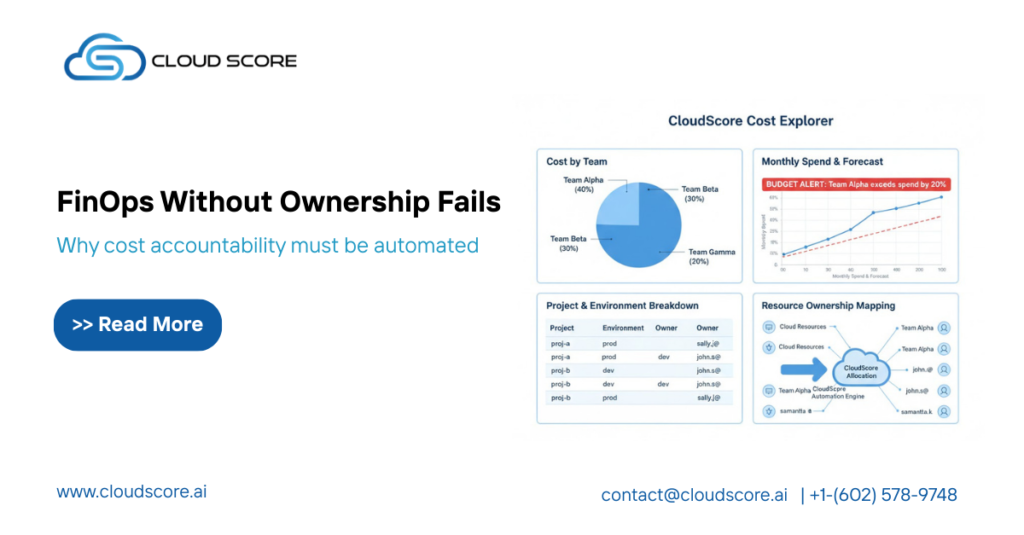
Costs are broken down by team, BU, application, service, environment, and user, with daily, monthly, and yearly views.
Budgets, Forecasts & Anomaly Detection
Teams receive real-time alerts for spend spikes, forecast overruns, and unusual behavior—before budgets are exceeded.
Shared Accountability Workflows
FinOps becomes a shared responsibility across engineering, finance, and leadership, not a finance-only process.
Slack & Jira Integration
Ownership and action happen where teams already work—not in isolated dashboards.
FinOps That Actually Scales
FinOps doesn’t fail because teams don’t care.
It fails because systems don’t enforce accountability.
 Request a Demo | Start Your Free Trial | Contact Our Experts
See More Blogs: FinOps and SecOps Convergence | DevOps Cloud Cost Visibility | Code Scan | Power Schedules | Multi Cloud Cost Optimization | Untagged Cloud Resources | Best Cloud Governance Solutions | SecOps & FinOps Cloud Governance | AI-Driven FinOps | AI Cloud Cost Optimization | Smart Cost Management | Simplify Cloud Costs | Automated FinOps Platform | Multi-Cloud Spend | Cost Efficiency | Cloud Security | Dynamic Optimization | Seasonality Insights | Cloud Governance | Sustainability Reporting | Cloud Infrastructure | Predictive Analytics | Integrating FinOps | Forecasting | Automated Cost Management | Cloud Cost Optimization