
DevOps Environment Sprawl: The Hidden Cost of Rapid Cloud Development
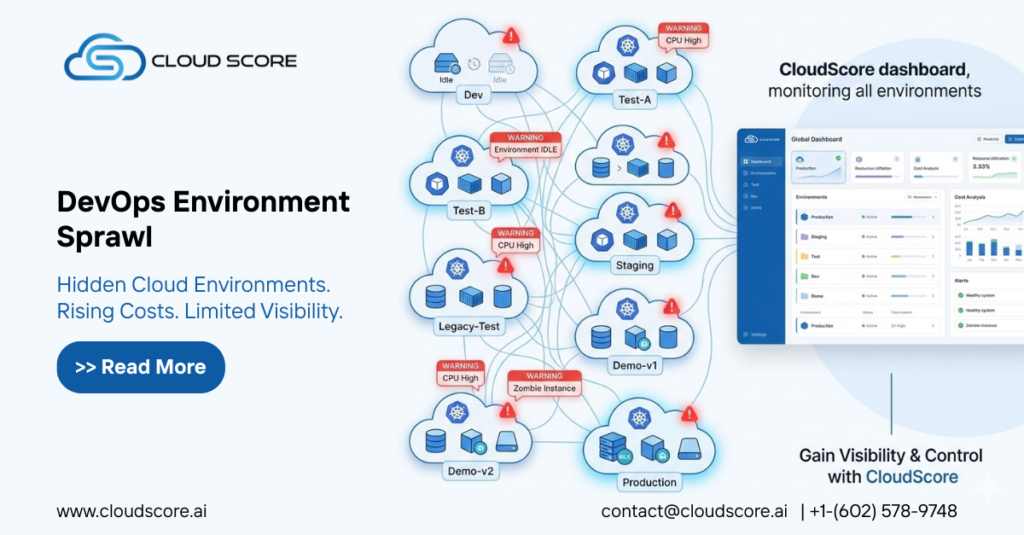
Automation Solved Speed and Created a New Problem Modern DevOps practices transformed how software is built and delivered.Engineering teams can now provision infrastructure in minutes, deploy continuously, and test new ideas at massive scale. Automation has made experimentation faster and development cycles shorter. But speed introduces a new challenge many teams overlook: DevOps environment sprawl. Every development workflow generates multiple environments such as: Temporary development environments Test and preview environments Feature-based infrastructure setups Demo and staging systems Many of these environments serve a short-term purpose.Yet once the task is complete, they often remain running long after they are needed. Over time, these unused environments accumulate across cloud accounts and clusters. What started as a productivity advantage gradually turns into hidden infrastructure growth. Why DevOps Environment Sprawl Is So Hard to See DevOps environment sprawl rarely appears as an obvious problem. Most teams don’t notice it because the environments are created automatically as part of normal development activity. Several factors make the issue difficult to detect: Resources are provisioned programmatically Ownership is unclear across teams Environments are distributed across multiple cloud accounts and clusters Tags are missing, outdated, or inconsistent Costs are shared across nodes, containers, and services By the time cloud spending reports surface unusual costs, the environments responsible may already be inactive or difficult to trace. The result is infrastructure that quietly consumes resources without anyone actively managing it. The Real Cost of Uncontrolled DevOps Environments When DevOps environment sprawl grows unchecked, the impact spreads beyond cloud costs. Organizations often encounter issues such as: Idle compute instances running for weeks Orphaned storage volumes and snapshots Underutilized Kubernetes clusters Security exposure from forgotten services Budget overruns with no clear ownership These problems are rarely caused by poor engineering practices. Instead, they emerge when fast-moving development environments lack visibility and lifecycle management. Without clear insight into what environments exist and who owns them, teams struggle to maintain control. How CloudScore Brings Order to DevOps Environments CloudScore is designed for engineering teams managing complex cloud infrastructure. Instead of slowing development workflows, it provides visibility and automation to control DevOps environment sprawl. Unified Environment Visibility CloudScore automatically discovers development, testing, staging, demo, and production environments across multiple clouds and Kubernetes clusters. Environment-to-Cost Mapping Every environment is mapped to teams, services, and owners, allowing organizations to understand the real cost impact of each workload. TTL & Power Management Rules Temporary environments can follow automatic shutdown policies, ensuring they do not remain active longer than necessary. Usage & Lifecycle Tracking Teams can see when environments were created, how long they have been running, and whether they are still actively used. Slack & Jira Workflows Environment planning, monitoring, and actions integrate directly into collaboration tools already used by DevOps teams. Automation Needs Control – Not More Process Automation accelerated development and innovation. However, without visibility, it also enabled DevOps environment sprawl to grow unnoticed. When environment lifecycle and ownership become visible, teams can maintain development speed while keeping infrastructure under control. Automation works best when it is paired with governance and intelligent cost visibility. Take Control of DevOps Environment Sprawl If your teams are deploying faster than ever but cloud costs keep rising, DevOps environment sprawl may be the missing piece. CloudScore helps engineering teams: 1. Discover hidden environments across multi-cloud and Kubernetes2. Track environment ownership and lifecycle3. Automatically control temporary environments4. Reduce unnecessary infrastructure costs5. Maintain visibility without slowing development Start seeing where your cloud environments are growing and where they should stop. Request a Demo | Start Your Free Trial | Contact Our Experts See More Blogs: FinOps Cloud Cost Ownership | FinOps and SecOps Convergence | DevOps Cloud Cost Visibility | Code Scan | Power Schedules | Multi Cloud Cost Optimization | Untagged Cloud Resources | Best Cloud Governance Solutions | SecOps & FinOps Cloud Governance | AI-Driven FinOps | AI Cloud Cost Optimization | Smart Cost Management | Simplify Cloud Costs | Automated FinOps Platform | Multi-Cloud Spend | Cost Efficiency | Cloud Security | Dynamic Optimization | Seasonality Insights | Cloud Governance | Sustainability Reporting | Cloud Infrastructure | Predictive Analytics | Integrating FinOps | Forecasting | Automated Cost Management | Cloud Cost Optimization